2.0 TDI Reinforced Hex Drive PinVersion 3.1 · oil pump hex shaft
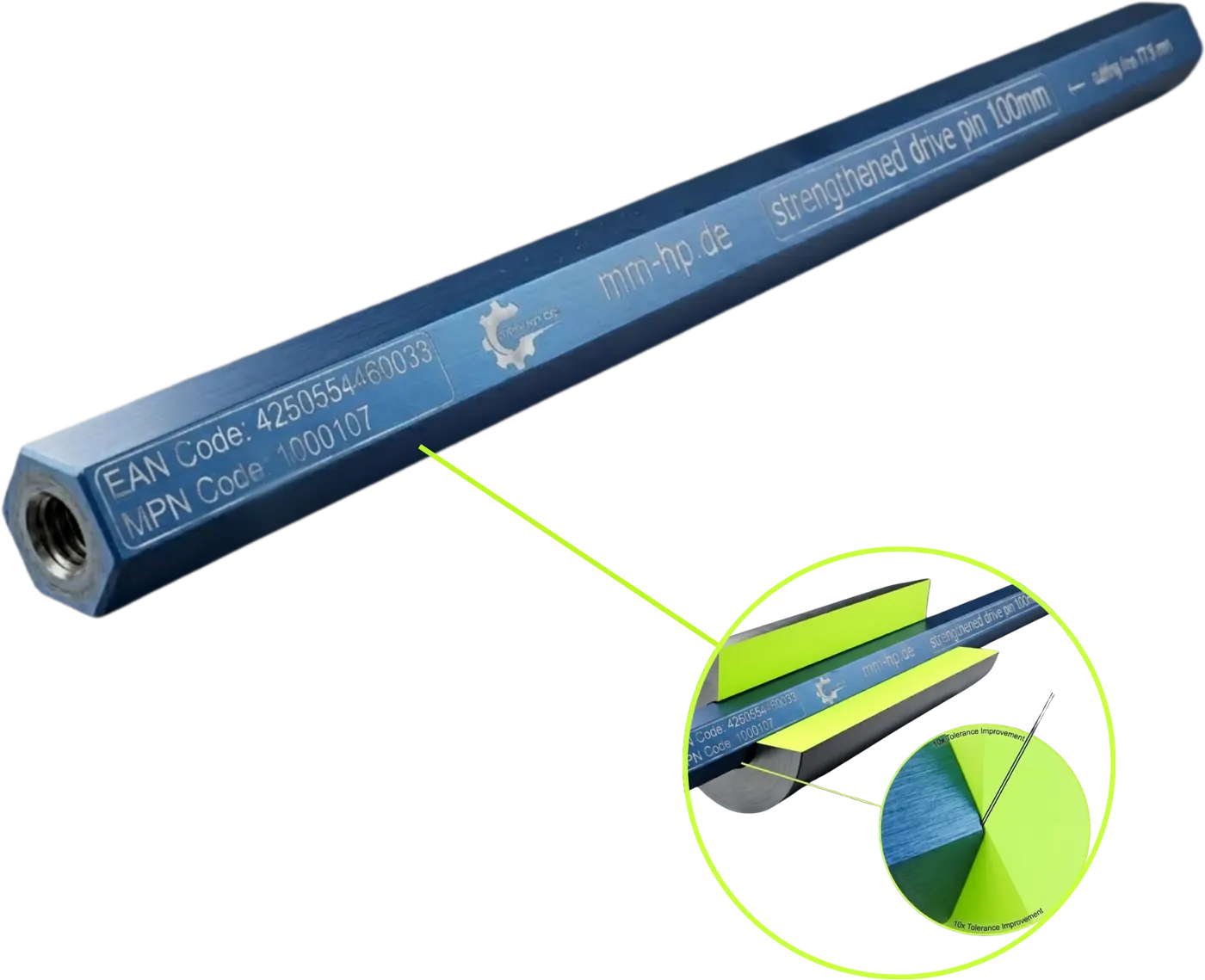
Does your 2.0 TDI have a balancer shaft module? Inside it, a small hex pin, the drive pin, drives the oil pump. Once it wears round, the pump stops and oil pressure is gone. We make this reinforced hex drive pin with 10× less play than the factory part.
Drive pin or balancer shaft module removal: two ways for the 2.0 TDI
Both from MMHP
The reinforced drive pin makes the hex connection more durable as long as the hex sockets (the bushings in the balancer shaft and oil pump that the drive pin sits in) are intact (which only shows with the oil pan off; if in doubt, go straight for the conversion kit). The cause stays: the small factory oil pump and the module keep working (what the drive pin can and cannot do). If you want to defuse the acute risk quickly, replace the drive pin: it lowers the risk of the hex spinning freely and the pump stopping.
If you want to relieve the engine for the long run, take the module out completely. With the conversion kit, the module, the original pump and the drive pin come out; a larger MMHP oil pump runs directly on a chain with its own tensioner. You no longer need the drive pin after that.
| Compared | Reinforced drive pin | Conversion kit to remove the module, stage 2 |
|---|---|---|
| Price | €89.90 | €468 at extra cost; stage 1 from €299 |
| What is replaced | the hex pin between balancer shaft and oil pump | module, original oil pump and drive pin come out, a larger chain-driven oil pump goes in |
| What it solves | Fits with 10× less play, smaller knocks at every load change; the cause remains | The hex connection no longer exists; +116% delivery rate |
| What remains | Small factory oil pump, module with its bearings; wear continues, only more slowly | Without balancer shafts the engine runs a little differently (what changes) |
| Fitting | Oil pan off, about 1 to 2 h | bigger job, about 2 to 4 h |
| Right for you if | you want to lower the acute risk that the oil pump is no longer driven, and the hex sockets (the bushings in the balancer shaft and oil pump that the drive pin sits in) are intact. That only shows with the oil pan off. If in doubt, go straight for the conversion kit. | you plan to keep the engine for a long time and want to get rid of the hex drive altogether |
Prices come from the shop every hour; delivery rate as stated on the conversion kit in the shop. Fitting times are averaged experience; they depend on engine variant, engine position and skill. For the conversion we recommend stage 2, because it brings more reserve for what cannot be measured on a used engine.
2.0 TDI hex worn round: what happens in the engine
When the drive pin wears round. At the bottom of the engine, in the oil pan, the balancer shaft drives a small pin, the drive pin, through a hex socket (bushing). The drive pin drives the oil pump. It has play and takes a knock with every load change; over time its edges wear round. Once it is round, the socket spins freely, the pump stops and oil pressure drops away. Only now, with almost no pressure left, do the warning light and chime come on, and until the driver reacts, the engine runs for seconds without oil.
In the simulator you can try for yourself how play and engine speed load the hex. The mechanics step by step are in the wiki chapter on the hex.
The oil pump drive in the 2.0 TDI is under-engineered from the factory.
That is our claim, on our own site. It does not stand alone.

By the time the red light comes on, the damage has
already been done.
VW and Skoda confirmed case numbers
in the three-digit range
to the editorial team, and Audi ran
service campaign 13D7 in response.
- Report
- “VW-Konzern-Motor 2.0 TDI: Ärger mit der Ölpumpe”, 7 May 2013
- Covers
- Pump-injector engines, built 2005 to 2009
- Quotation
- Excerpt, published in German, translated by us
Replacing the oil pump hex shaft: cost on the 2.0 TDI
Part and labor
Every option means taking the oil pan off. The difference lies in the part, the time at the open engine and what remains afterwards. We do not quote workshop prices, they vary too much; labor cost depends on your workshop's hourly rate.
| Option | Part | Labor | What remains |
|---|---|---|---|
| Do nothing | €0 today | none | The hex keeps wearing, usually without warning. When the oil pressure light comes on, the engine is already running almost without pressure. |
| New factory drive pin | original part from a parts dealer | oil pan off, same effort as for the MMHP drive pin | The same play as from the factory; wear starts over. |
| Reinforced MMHP drive pin | €89.90 with eGuide (shop price, checked hourly) | oil pan off, about 1 to 2 h, in some cases up to 3 (MMHP experience) | 10× less play, more durable while the hex sockets are intact (only visible with the oil pan off). Wear continues, only more slowly; the small factory oil pump stays. |
| Needed for every option | oil, oil filter, sealant for the oil pan | included in the time above | – |
When the drive pin alone is no longer enough: if the hex socket in the balancer shaft or the pump is already worn out, a new drive pin will not sit tight there either. You only see this with the oil pan off; then the conversion is the option to consider. The oil pan is already off by then, but the conversion takes longer (about 2 to 4 h).
2.0 TDI with or without balancer shaft module?
Does the drive pin fit my engine
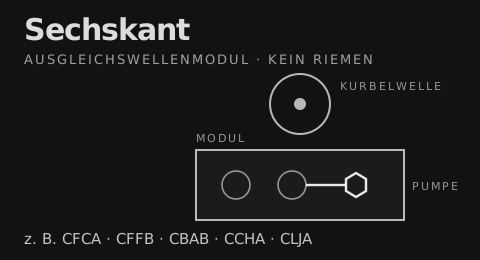
The reinforced drive pin fits the 2.0 TDI with balancer shaft module, whether pump-nozzle or common rail. There, the oil pump sits in the module below the crankshaft and is driven via the hex (which engines have a module).
Pump-nozzle with module is found mainly in the Passat B6, Sharan, Audi A4 B7, A6 C6 and Superb (e. g. BKP, BMP, BRE, BLB). Pump-nozzle without module from the factory is fitted to the Golf V, A3 8P, Octavia II and Touran (BKD, BMM, BMN, AZV); the drive pin does not fit there, and the chain conversion below is not meant for it either. The solution finder shows what fits. Common rail with module is the EA189, e. g. CFFB, CBAB, CCHA.
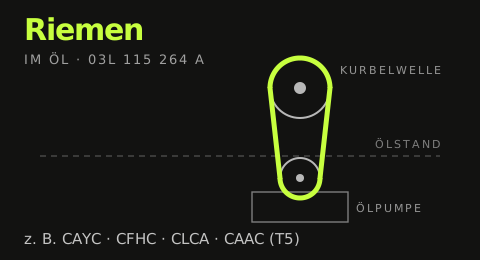
If the oil pump is driven by a timing belt running in oil, it is the other EA189 design: EA189 chain conversion. A later EA288 is a different engine again: EA288 chain conversion.
Whether your vehicle fits is checked in the shop using the vehicle registration data. If you only know “2.0 TDI”, the solution finder takes you to the engine design.
We supply the long 100 mm version; some engines need the short 77.5 mm one. Which length your engine has only shows during fitting, so only shorten it once you have measured on the open engine. The drive pin carries a cutting mark, and the eGuide shows how to shorten it.
Measured in backlight: play of the 2.0 TDI drive pin 3.1 vs. the factory part

Drag the slider in the image to see the difference.
Original VW hex drive pin vs. MMHP drive pin
On the left the factory part, on the right the MMHP drive pin, both backlit in the hex socket. With the MMHP drive pin the gap to the socket is much smaller; there is still room for the film of engine oil.
Less play means smaller knocks at every load change. Since 2015 we have developed the drive pin in four stages: 1.0 hardened (2015), 2.0 with adjusted size and coating (2017), 3.0 with tighter tolerances (2021), 3.1 with refined fit and hardening (2024, current).


Fit, hardness, coating of the 2.0 TDI drive pin
What is different about the part
Fit: the size is larger than the factory part and fits hex sockets made to factory dimensions: original VW oil pumps and the MMHP pump, even where the two sockets are not perfectly aligned. We advise against replica pumps from other makers: their socket dimensions are often off, so the play is too large or the drive pin does not fit at all.
Flanks: without edge radii, finely ground and flat, so they bear over their full area.
Material: harder than the factory part without becoming brittle, plus a hard coating from toolmaking against wear.
Where “10× less play” comes from: The figure comes from a customer’s measurement comparing the factory part with the MMHP drive pin; we measured it again: about one tenth of the play. Zero play is not possible: we only go down to a minimum play so that the drive pin fits hex sockets made to factory dimensions (original VW oil pumps and the MMHP pump). The formula, measurement data and our production tolerances stay in-house. The drawing shows the gap greatly enlarged.
Fitting the drive pin: oil pan, time, eGuide
Yourself or at the workshop
To replace it, the oil pan has to come off; the drive pin sits between balancer shaft and oil pump. A workshop needs about 1 to 2 hours, in some cases up to 3. That is averaged experience; it depends on engine variant, engine position and skill.
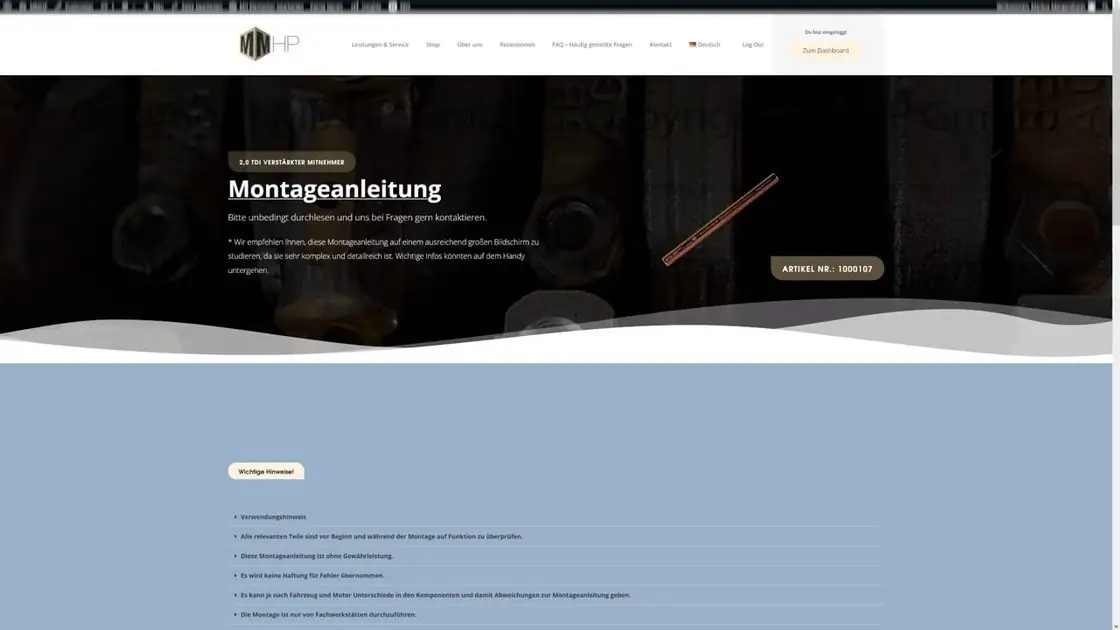
In the box: the drive pin (100 mm, with cutting mark), a circlip plus a spare, a fitting aid and the eGuide, the online fitting guide with step-by-step pictures and text, plus notes on the 2.0 TDI from many years of experience. Here is a censored excerpt:
Checking fit: 2.0 TDI with balancer shaft module by documents or engine code
Two ways, one minute
By engine code: it is on the engine or in the vehicle documents. With it, the solution finder tells you which design your engine has.
German registration documents: enter HSN and TSN (fields 2.1 and 2.2) in the shop; the engine code is in field D.2.
You only know “2.0 TDI”? The solution finder still helps, in three steps via make and model.
2.0 TDI oil pump hex shaft: questions before you decide
Short answers, click a question
Does the reinforced drive pin fit my 2.0 TDI?
If your 2.0 TDI has a balancer shaft module: yes, pump-nozzle and common rail alike. The shop checks it bindingly; the solution finder takes you to the engine design. Engines that have no module from the factory and engines with an oil pump belt do not fit (section 04).
How do I know the oil pump hex is worn?
Usually not at all beforehand. The oil pressure light only comes on when there is hardly any pressure left. If it comes on or flickers, stop safely, engine off, do not drive on and have a workshop measure the oil pressure: not every warning is the hex, a faulty oil pressure switch or diluted oil can also be the cause (oil dilution in the wiki).
Replace the hex as a precaution, even at high mileage?
There is no fixed mileage. The hex wears with every load change, and how far it has gone can only be seen with the oil pan off. If you are working at the oil pan anyway, replace it at the same time, provided the hex sockets (the bushings in the balancer shaft and oil pump that the drive pin sits in) are still intact. At high mileage that is not certain; if they are worn out, the conversion kit is the right way.
Is the drive pin alone enough, or does the balancer shaft module need replacing?
The drive pin slows the wear as long as the hex sockets are sound, but does not stop it. Whether they are sound only shows with the oil pan off; if in doubt, go straight for the conversion kit. The cause (small pump, module) remains. If the hex socket in the balancer shaft or pump is already worn out, a new drive pin will not hold there either; then the conversion kit to remove the module is the better option than a new module.
Does the hex problem affect pump-nozzle or common rail engines?
Both, as long as a balancer shaft module is fitted: pump-nozzle with module (such as Passat B6, Audi A4 B7) and the EA189 common rail share the same hex drive. Pump-nozzle without module from the factory (Golf V, A3 8P, Octavia II, Touran) drives the oil pump differently; the drive pin is not intended for it.
Which length of drive pin does my engine have?
That only shows during fitting. We supply the 100 mm version with a cutting mark; if your engine needs the short 77.5 mm one, shorten it on site, the eGuide explains how.
Do I still need the drive pin after the conversion?
No. The conversion removes the module, the original oil pump and the drive pin; the new oil pump runs on a chain.
Stage 1 or stage 2 for the conversion?
We recommend stage 2 (+116% delivery rate) for €468; stage 1 (+35%) costs from €299. Details on the conversion page.
Can I fit the drive pin myself?
Yes, if you have removed and refitted an oil pan before. With the oil pan off, check the hex sockets first; if they are worn out, do not fit the drive pin, choose the conversion kit instead. The car must stand securely on supports, the oil pan goes back on with fresh sealant, then fresh oil and filter. The eGuide takes you step by step. Without that experience, give the part and the eGuide to your workshop.
For the 2.0 TDI with balancer shaft module, pump-nozzle and common rail, €89.90 in the MMHP shop, with eGuide. Not for engines that have no module from the factory.