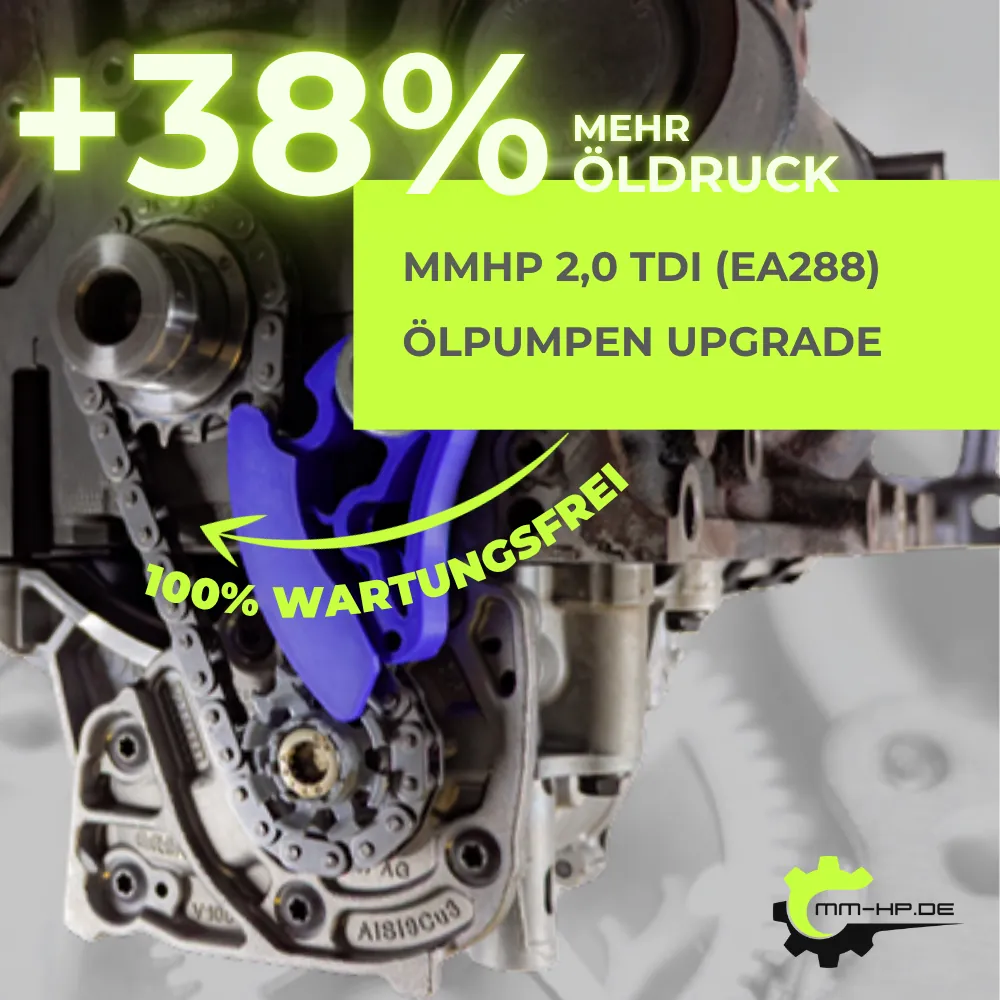
EA288 Oil Pump Belt in Oil: Convert the Oil Pump to Chain Drive+38% pump output · no interval any more · Gen 1, not evo
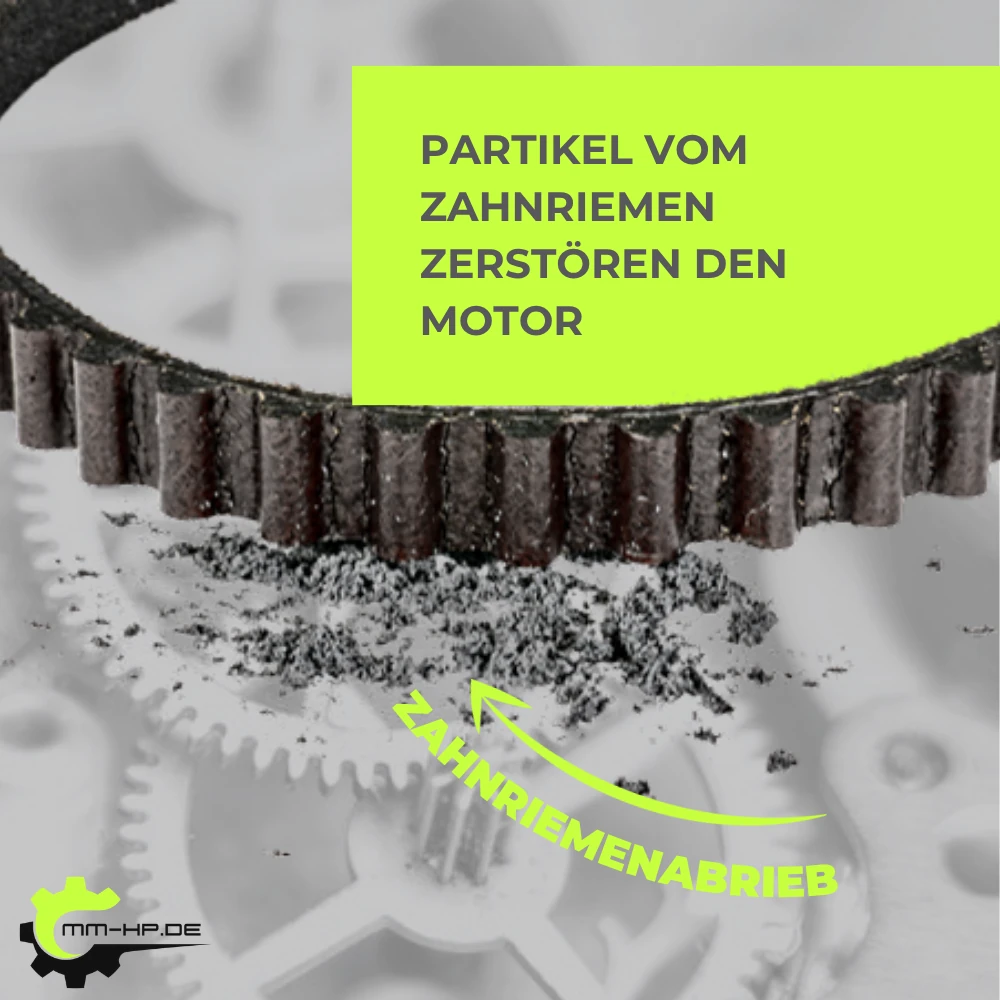
On the 1.6 and 2.0 TDI EA288 the oil pump belt runs in the engine oil and sheds material from day one.
EA288 oil pump belt: the problem
Two belts, one in oil
The EA288 has two toothed belts. The familiar one at the front drives the camshafts, dry. A second, short one sits at the rear of the crankshaft and drives the oil pump, and that one runs in the engine oil. There is no replacement interval for it; VW calls it maintenance-free in self-study programme 514, meaning: no replacement date in the service schedule. Why VW put the belt into the oil at all (less friction, less CO2) is explained in the wiki.
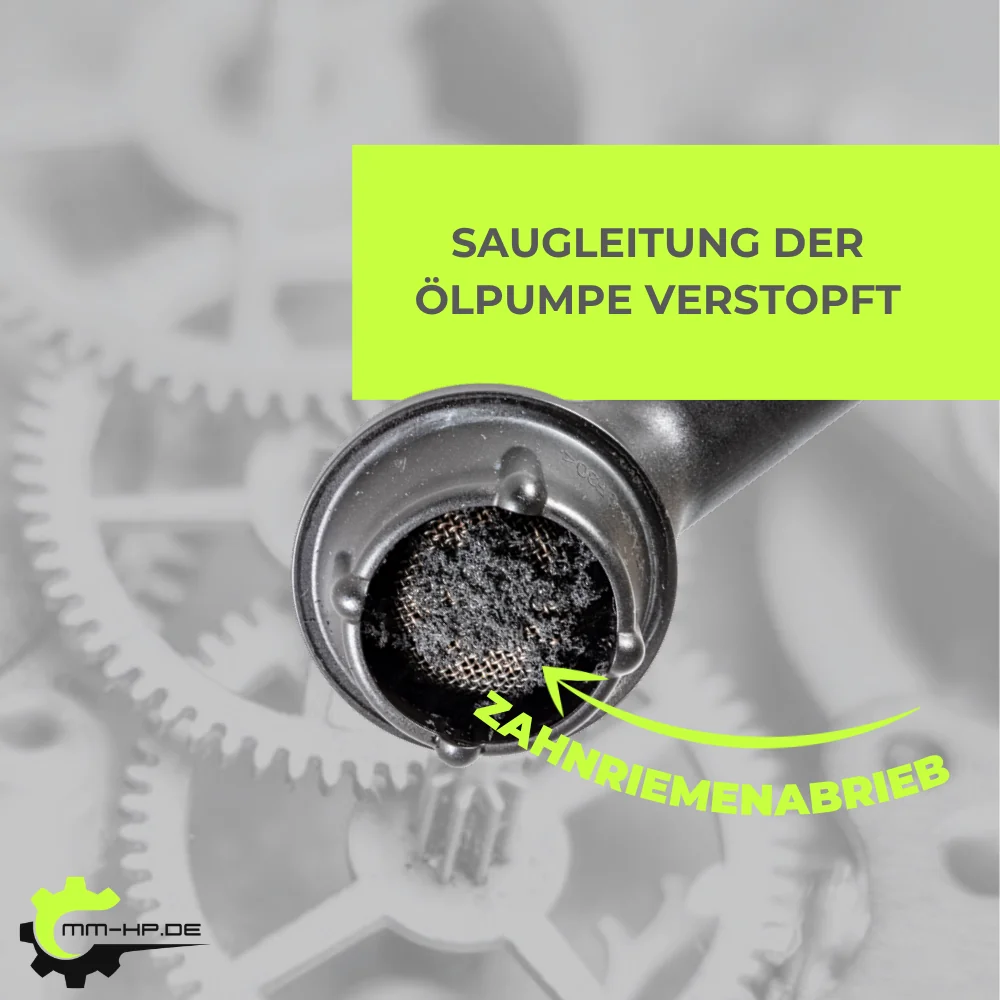
Oil attacks the rubber, and every belt running over two sprockets sheds debris. The particles end up on the oil pump pickup strainer and, as soon as the oil filter bypass valve opens, unfiltered throughout the engine. Why that happens, station by station: MMHP wiki, timing belt in oil.
On the EA288 there is often one more thing: on many engines the vacuum pump sits inside the oil pump, on the same shaft (SSP 514). If the belt snaps there, you lose not only oil pressure but also brake assistance.
You will not notice it for a long time; oil pressure stays normal until the strainer is blocked far enough. What can still be checked (used oil, fault memory, strainer) is in the wiki chapter “How to tell”.
Does the chain conversion fit my EA288? All engines and vehicles
1.6 and 2.0 TDI EA288 · 134 engine codes · 54 models
Fits all generation 1 EA288 with the 04L oil pump on the engine block. Does not fit: generation 2 (evo, 05L oil pump), e.g. DTRA, DTSA, DFBA. Engine code: registration document, field D.2; by HSN/TSN the solution finder checks it.
54 models · 4 makes · 134 engine codes
A model can be built with different engines, including the generation-2 EA288 (evo), which the conversion does not fit. Only the engine code tells whether it fits.
Volkswagen28 models
| Model | Built | Power |
|---|---|---|
| ARTEON | 2017–present | 150/190 PS |
| ARTEON SHOOTING BRAKE | 2020–present | 190 PS |
| BEETLE | 2014–2018 | 150 PS |
| BEETLE Cabriolet | 2014–2018 | 150 PS |
| CADDY ALLTRACK MPV | 2015–present | 75/102/122/150 PS |
| CADDY ALLTRACK panel van/MPV | 2015–present | 75/102/122/150 PS |
| CADDY IV MPV | 2015–2020 | 75/102/122/150 PS |
| CADDY IV panel van/MPV | 2015–2020 | 75/102/122/150 PS |
| GOLF ALLTRACK VII | 2014–present | 110/150/184 PS |
| GOLF ALLTRACK VII Variant | 2014–present | 110/184 PS |
| GOLF SPORTSVAN | 2014–present | 110/150 PS |
| GOLF SPORTSVAN VII | 2014–present | 90/110/115/150 PS |
| GOLF VAN VII Variant | 2013–2017 | 110 PS |
| GOLF VI Cabriolet | 2013–2016 | 150 PS |
| GOLF VII | 2012–present | 90/105/110/115/150/184 PS |
| GOLF VII Van | 2012–present | 105/110 PS |
| GOLF VII Variant | 2013–present | 90/105/110/115/150/184 PS |
| PASSAT | 2014–present | 150 PS |
| PASSAT ALLTRACK | 2015–2017 | 150 PS |
| PASSAT ALLTRACK B8 Variant | 2015–present | 190 PS |
| PASSAT B8 | 2014–present | 150/190 PS |
| PASSAT B8 Variant | 2014–present | 150/190 PS |
| PASSAT Variant | 2014–present | 150 PS |
| SCIROCCO III | 2013–2017 | 150 PS |
| T-ROC | 2018–present | 115/190 PS |
| TIGUAN | 2016–2020 | 150/190 PS |
| TIGUAN ALLSPACE | 2017–present | 150/190 PS |
| TOURAN | 2015–present | 110/150/190 PS |
Audi11 models
| Model | Built | Power |
|---|---|---|
| A1 | 2014–2018 | 115 PS |
| A1 Sportback | 2014–2018 | 115 PS |
| A3 | 2012–present | 105/110/115/143/150/184 PS |
| A3 Cabriolet | 2013–present | 110/115/150/184 PS |
| A3 Limousine | 2013–present | 105/110/115/143/150/184 PS |
| A3 Sportback | 2012–present | 105/110/115/143/150/184 PS |
| Q2 | 2016–present | 115/150/190 PS |
| Q3 | 2018–present | 190 PS |
| Q3 Sportback | 2019–present | 190 PS |
| TT | 2014–present | 184 PS |
| TT Roadster | 2014–present | 184 PS |
Seat6 models
| Model | Built | Power |
|---|---|---|
| ATECA | 2016–present | 115/190 PS |
| LEON | 2012–present | 90/105/110/115/184 PS |
| LEON panel van/hatchback | 2012–2016 | 90/105 PS |
| LEON SC | 2013–present | 90/105/110/115/184 PS |
| LEON ST | 2013–present | 90/105/110/115/150/184 PS |
| TARRACO | 2018–present | 150/190 PS |
Škoda9 models
| Model | Built | Power |
|---|---|---|
| KAROQ | 2017–present | 115/190 PS |
| KODIAQ | 2016–present | 150/190 PS |
| OCTAVIA III | 2012–present | 90/105/110/115/184 PS |
| OCTAVIA III Combi | 2012–present | 90/105/110/115/184 PS |
| RAPID | 2015–2019 | 115 PS |
| RAPID Spaceback | 2015–2019 | 115 PS |
| SUPERB III | 2015–present | 150/190 PS |
| SUPERB III estate | 2015–present | 150/190 PS |
| YETI | 2015–2017 | 150 PS |
Engine codes the conversion fits134 codes
CKFB CKFC CLHA CLHB CNHA CNHB CNHC CRBB CRBC CRBD CRFA CRFC CRGB CRKA CRKB CRLB CRLC CRLD CRMB CRUA CRVA CRVC CSUA CSUB CSUD CSUE CUAA CUNA CUPA CUUA CUUB CUUD CUUE CUUF CUVA CUVB CUVC CUVD CUVE CUWA CUXA CVCA CXEB CXEC CXFA CXGA CXGB CXGD CXHA CXHB CXHC CXMA CXXA CXXB CYKA CYKB CYKC CYLA CZHA CZJA DASA DASB DASC DAUA DAUB DAVA DAWA DBBA DBGA DBGB DBGC DBKA DCXA DCYA DCYB DCZA DDAA DDCA DDCB DDDA DDYA DDYB DEJA DEJB DEKA DEKB DELA DESA DETA DETB DEUA DEUB DEUC DFCA DFEA DFEB DFFA DFGA DFGB DFGC DFHA DFLA DFLD DFMA DFSA DFSB DFSC DFSD DFSE DFSF DFTA DFTB DFTC DFUA DFVA DGCA DGDA DGDB DGMA DGTA DGTC DGTD DGTE DJGA DLTA DLTC DLUB DMZA DMZB DNAA DNAB DNAC DNAD DNAE
As of 1 October 2026, from our fitment database (PS = metric horsepower). Models marked “–present” also come with generation evo engines (05L oil pump), where the conversion does not fit: the engine code decides, not the model. The shop verifies the binding fitment with your vehicle. More depth in the MMHP wiki “Timing belt in oil”: affected engines · find your engine code · symptoms · replacement interval.
EA288 generation 1 or evo: the oil pump decides, the engine code tells you
Generation 1 or 2
Since 2020 there is a second generation, which VW calls the EA288 evo (Golf VIII, Passat B8 facelift, Audi A3 and A4 from model year 2020). Its oil pump belt runs in oil as well, even with the same part number 04L 115 264 A as on generation 1. So the belt does not tell you the generation.
The difference is where the oil pump is mounted. On generation 1 it sits on the engine block (pump number 04L). On the evo the upper sump section joins the block and the oil pump (05L) sits on that upper section (VW self-study programme 595); this shifts its angle relative to the crankshaft, which is why the chain conversion does not fit. All generation-1 engines (04L) fit, including those with a multi-piece 04L sump: the block and the seal flange are the same.
How to check without removing the sump: you cannot see the sump from above, and nobody has to take it off to look. The reliable way is the engine code. Enter it in the search above; every engine code with a 05L pump is listed there as “does not fit”. If you do not know it, the vehicle search in the shop finds your car by make and model.
Does generation 2 have the same belt problem? Same belt, same oil bath, so the same mechanism. The cars are younger; documented failures so far are individual reports, there are no statistics.
From which model year? Generation 1 from the start of production in 2012, and in the Caddy, Tiguan Allspace and other models alongside generation 2 to this day. There is no “safe” year; the engine code decides.
Beware of offers: conversion kits and engine overhauls on the market sometimes list generation-2 engine codes as fitting without mentioning the different pump position (market check 1 October 2026). Before any purchase, ask whether the seller excludes the 05L pump.
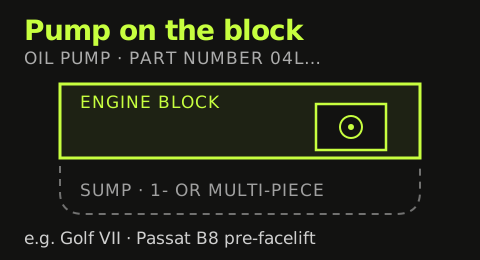
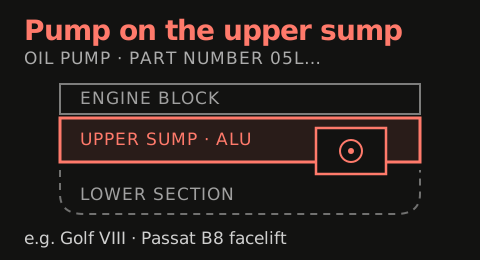
| Feature | Generation 1 | Generation 2 (evo) |
|---|---|---|
| Oil pump sits (the feature) | on the engine block | on the upper sump section (alu) |
| Oil pump (part number) | 04L… | 05L… |
| Oil pump belt | 04L 115 264 A | the same |
| Oil sump | mostly one piece, multi-piece on some codes | two-piece (not the feature) |
| How to check | Engine code in the search above, or your car in the shop’s vehicle search | |
| In production | from 2012 | from 2020 |
| Engine codes (examples) | CRLB · CUNA · DFGA · DCYA · CXXB · DGTE | DTRA · DTRC · DTSA · DTSB · DTUA · DFBA · DEZB |
| MMHP chain conversion | fits (search above) | does not fit |
Sources: VW self-study programmes 514 (EA288) and 595 (EA288 evo, pp. 33–34), Audi SSP 671, MMHP parts research 04L/05L, MMHP fitment database, as of 1 October 2026.
MMHP has a solution for the EA288 evo. The Gen-1 conversion does not fit and must not be installed.
Replace the belt or convert: what the EA288 costs
The numbers
VW specifies no replacement interval (why, in the wiki). A new belt and the chain conversion need the same access: sump and timing belt off, oil pump belt out, new crankshaft seal flange (ContiTech bulletin 11/2024), plus oil and filter for both. The difference is the part, the time at the open engine and what you are left with:
| Option | Parts | Labour | What remains |
|---|---|---|---|
| Do nothing, look after the oil | €0 today | none | The debris keeps coming, the condition stays unknown. By the time the oil pressure light comes on, the damage is usually done: turbocharger, bearings, in the worst case the engine, several thousand euros (auto motor und sport, 04/2026). |
| Replace the belt | Belt around €25–40 plus seal flange (retail, 30 Sept 2026; ContiTech bulletin 11/2024) | Sump and timing belt off, belt out, new flange; your workshop’s hourly rate | Debris from day one, oil pressure as low as from the factory. The next replacement comes without a fixed date, each time with the same work. |
| Chain (MMHP conversion) | €589 kit with special tools and eGuide (shop price, synced hourly) | the same access; conversion 2 to 3 h following the eGuide, sump and timing belt included, about half an hour to an hour more than “replace the belt” (MMHP experience); yourself or a workshop | No more rubber in the oil, 38% more pump output. Converted once, maintenance-free with no mileage limit. |
EA288 timing belt service: replace the oil pump belt too, or convert to chain?
The decision
The question usually comes up when the timing belt is due and the workshop offers to do the oil pump belt as well. It is a separate part (VW 04L 115 264 A) and usually not included in the standard timing belt kit; ask your workshop. Replacing it needs the timing belt and the sump off (one-piece or multi-piece depending on the engine). During a timing belt service the timing belt is off anyway, which leaves the sump. That makes this appointment the cheapest moment for either job:
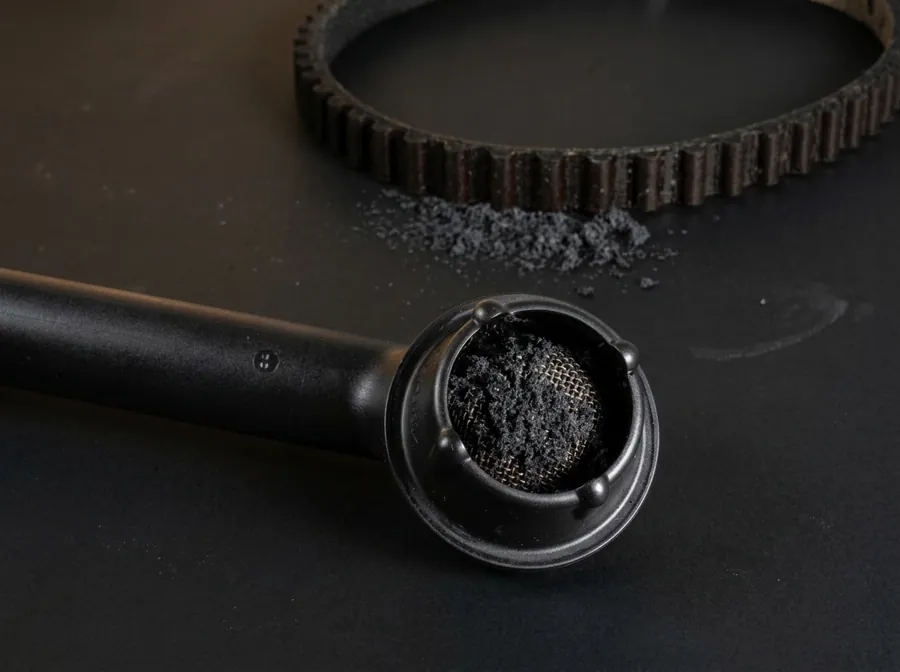
Right for you if you will part with the car in the next few years.
What remains: condition unknown, the wear keeps going; there is no interval to go by (why, in the wiki). How the strainer clogs is shown in the animation in the wiki.
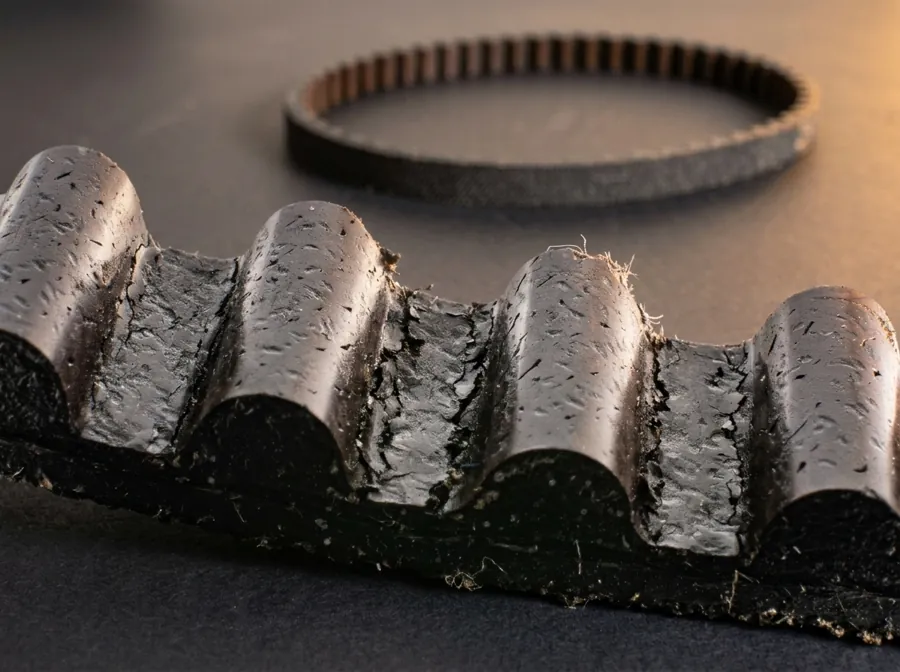
Labour: sump and timing belt off, again at every belt replacement
Right for you if you are prepared to have the belt replaced again and again without knowing when it is due.
What remains: the new belt also sheds debris into the oil from day one, the particles keep travelling through the circuit, and the oil pressure stays as low as from the factory. There is no replacement date here either, so the work comes back: sump and timing belt off every time, about 1½ to 2 hours of workshop time per replacement.
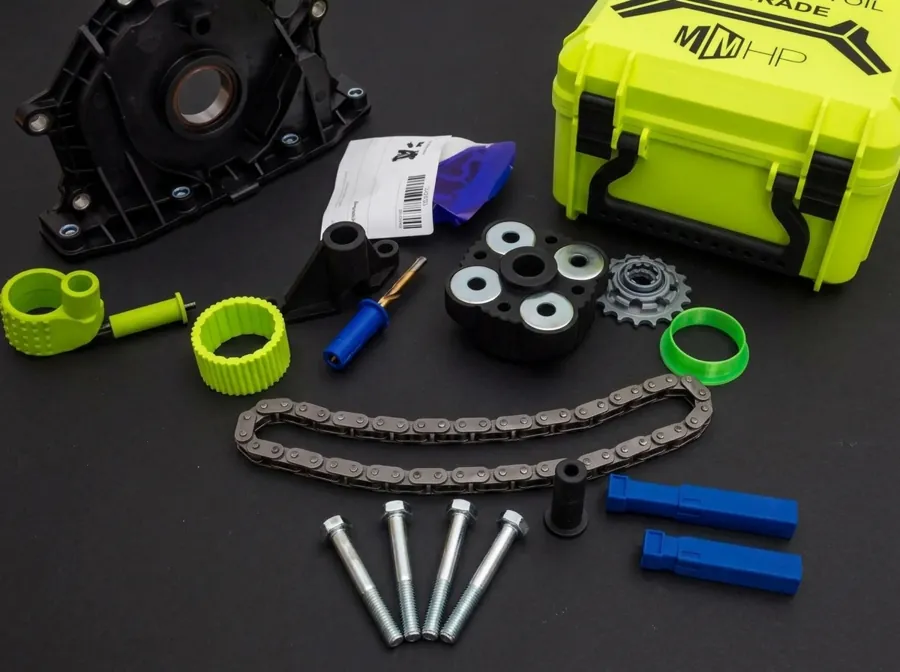
Access: the same, about ½ to 1 h more than “replace the belt”; seal flange is in the kit
Right for you if you want to keep the engine and answer the question only once.
What remains: no rubber in the oil, 38 % more delivery, maintenance-free with no mileage limit: even systems with several hundred thousand kilometres have shown no wear. The chain runs with a spring-loaded tensioner and guide rail: chains stretch during run-in, without a tensioner they slap (wiki). Ships the next working day, so order before the workshop appointment (installation).
Chain conversion in the shopWhy the conversion pays off: you pay for the bulk of the work, sump and timing belt off, again at every oil pump belt replacement. At the same appointment the conversion costs about half an hour to an hour more and saves every further replacement; depending on the hourly rate it has paid for itself after about two to three avoided belt replacements.
Timing belt already done, oil pump belt never mentioned? The conversion is still worth it, but it costs the labour a second time: sump and timing belt have to come off again (whether the freshly fitted timing belt can be refitted is for your workshop to decide according to VW specifications: a new or still young belt can usually go back on, beyond a certain mileage it pays to replace it as well). With the sump off, the strainer shows the findings, and the chain goes in during the same job. If the change is still ahead of you: settle it beforehand.
Documented findings on EA288 oil pump belts: cracks in the tooth roots, crumbs and shreds on the pickup strainer, a blocked pickup pipe (pictures in section 01), oil pressure faults in the fault memory, including on young vehicles. These are individual cases, there are no statistics, not even our own: it does not happen to everyone, but it does happen, and whoever leaves the belt in carries that risk themselves.
Independent of the belt: the standard pump delivers too little oil pressure at hot idle and low revs, and the usual workshop gauges of accuracy class 1.6 give no reliable reading below 1 bar, so workshops rarely notice it (oil pressure gauges · why we quote no bar values). The chain conversion adds 38 % delivery exactly there.
Converting the oil pump to chain drive: the MMHP solution and what we measured
The solution
The conversion removes the toothed belt and its sprockets and replaces them with a hardened roller chain, a spring-loaded chain tensioner and a guide rail. It does not work without a tensioner: every chain stretches slightly as it beds in, and an untensioned chain slaps and wears. The tensioner keeps the preload constant, even under load changes (why a chain drive without a tensioner is not an option).
The drive ratio is redesigned: 38 percent more pump output, and with it more oil pressure, across the whole rev range, especially at hot idle, where the standard pump has the least reserve. Why we state this in percent rather than in bar: oil pressure is not a fixed pump value but the result of the whole oil system, and every engine is unique.
More delivery also cools. More oil through the standard oil cooler lowers the oil temperature, by 10 to 15 degrees on average as measured on customer vehicles, and the jets cool the pistons earlier and harder; that protects the cylinder walls and slows the coking of the piston rings that drives oil consumption and blow-by. Derived in the wiki: oil temperature · oil consumption and blow-by.
What we measured. We are developers, not rebuilders. There was no oil pressure measuring equipment that satisfied us, so we built our own, hardware and software, and logged thousands of hours in customer vehicles: real pressures, real temperatures, real engine speeds. Add test rigs of our own design and test vehicles in continuous use; no part is released before it has run there. Those measurement series are the source of the VHFI, our own index; the curve below shows it schematically. How the VHFI is derived · Measurement and test rigs.
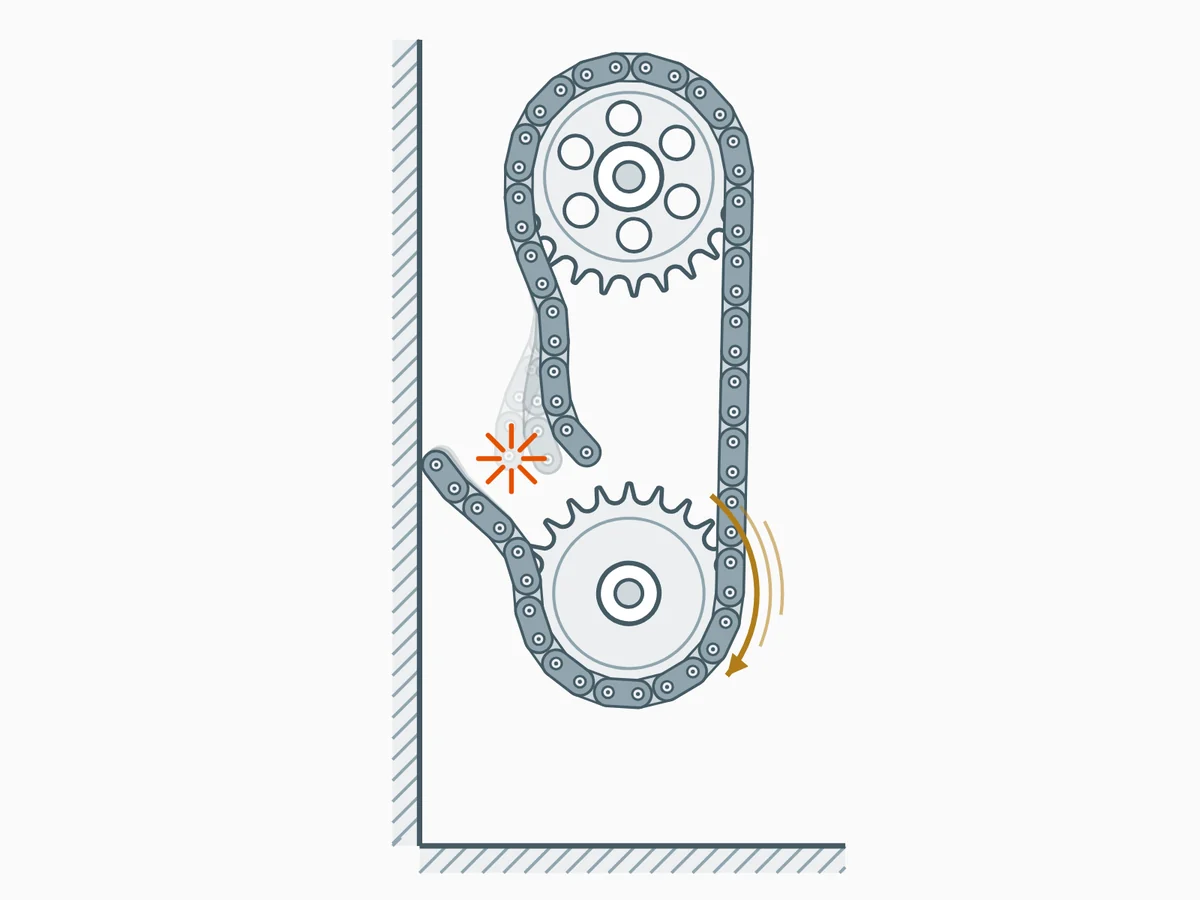 Without tensioner: the chain breaks
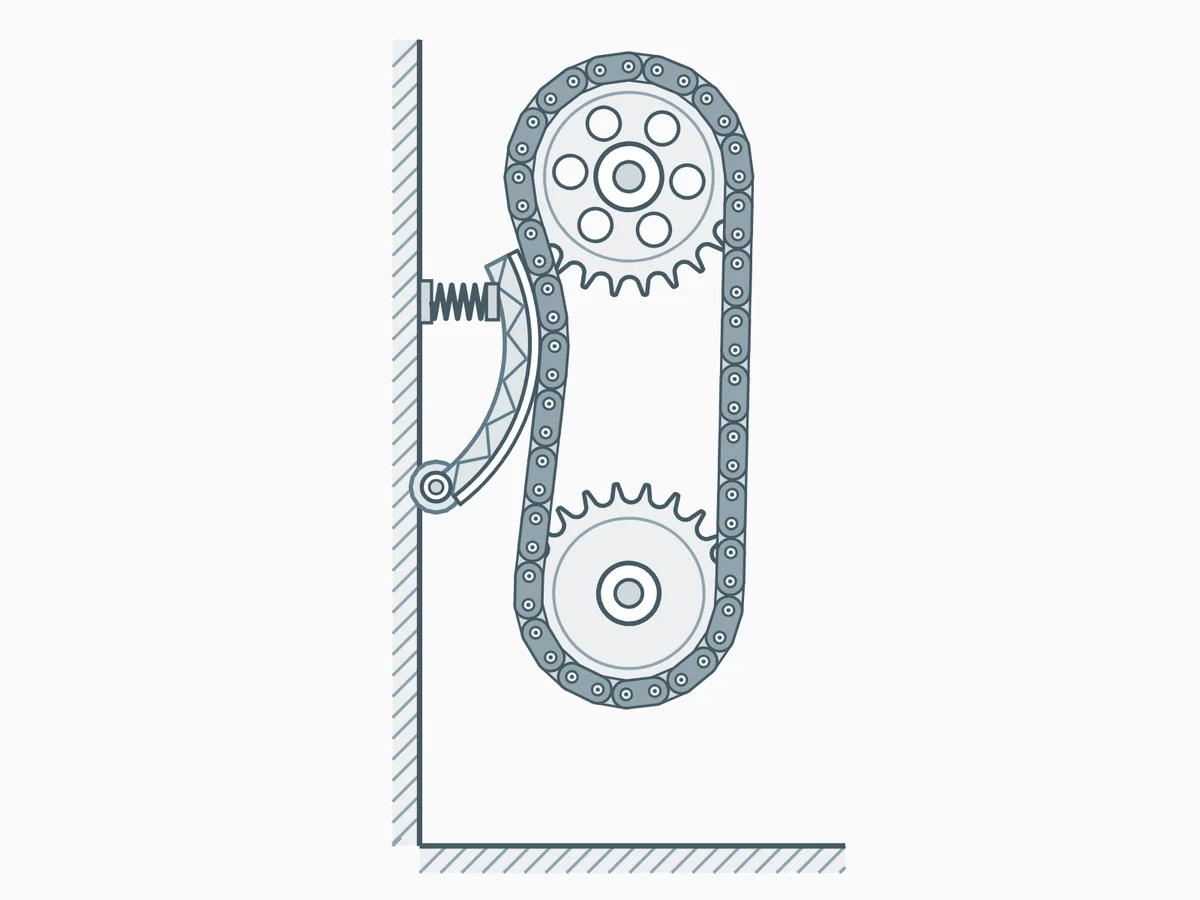 With tensioner and guide rail
A chain without a tensioner gets looser with every kilometre
Even a little stretch makes the slack side whip sideways; depending on engine speed a wave builds up, wear increases and the stretch keeps growing. In the end the chain jumps a tooth or breaks, and the oil pump stops while the engine keeps running.
That is why the MMHP conversion has a spring-loaded tensioner with a guide rail in the right place. It takes up the stretch and keeps the chain steady for its whole life.
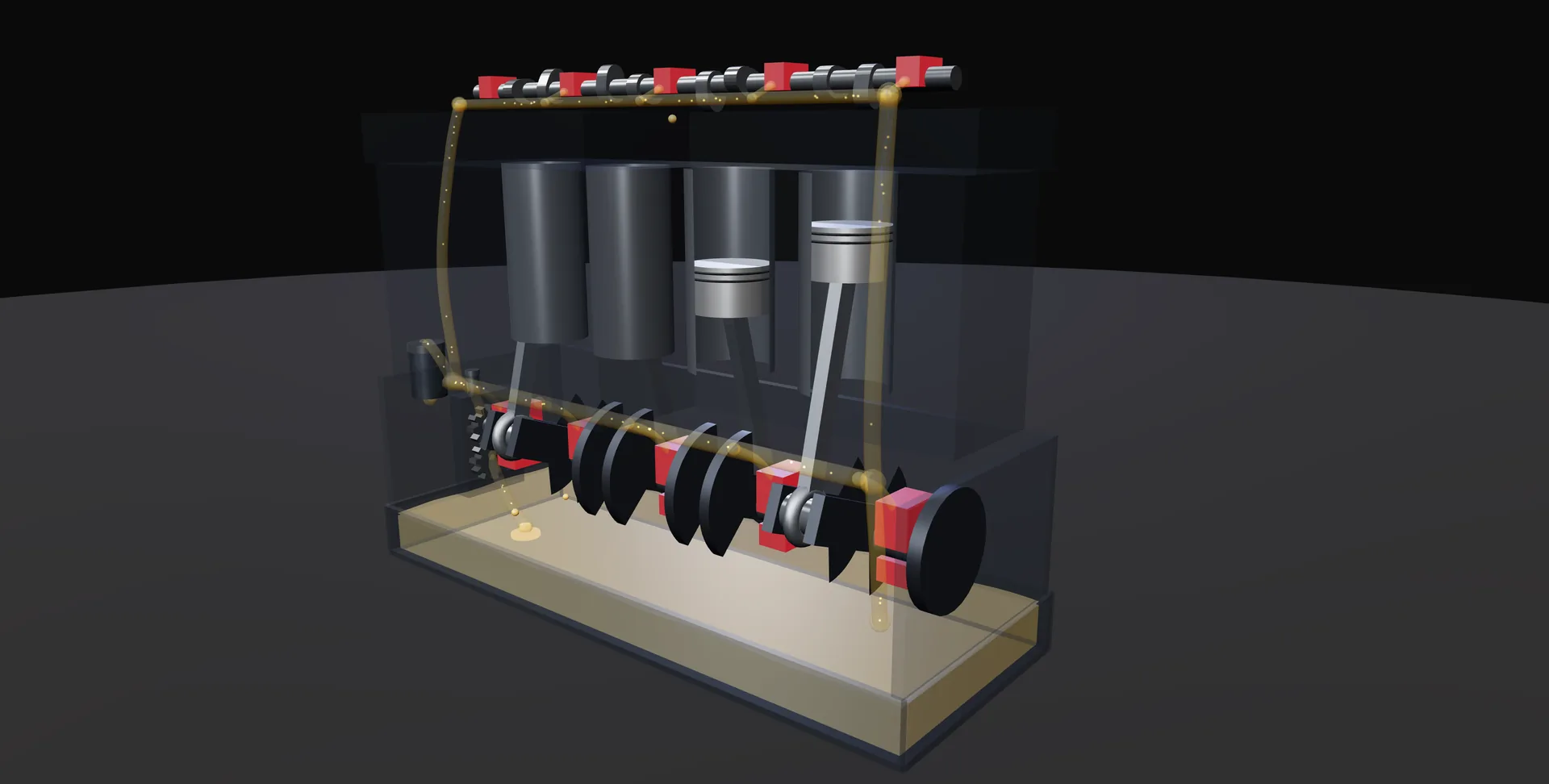
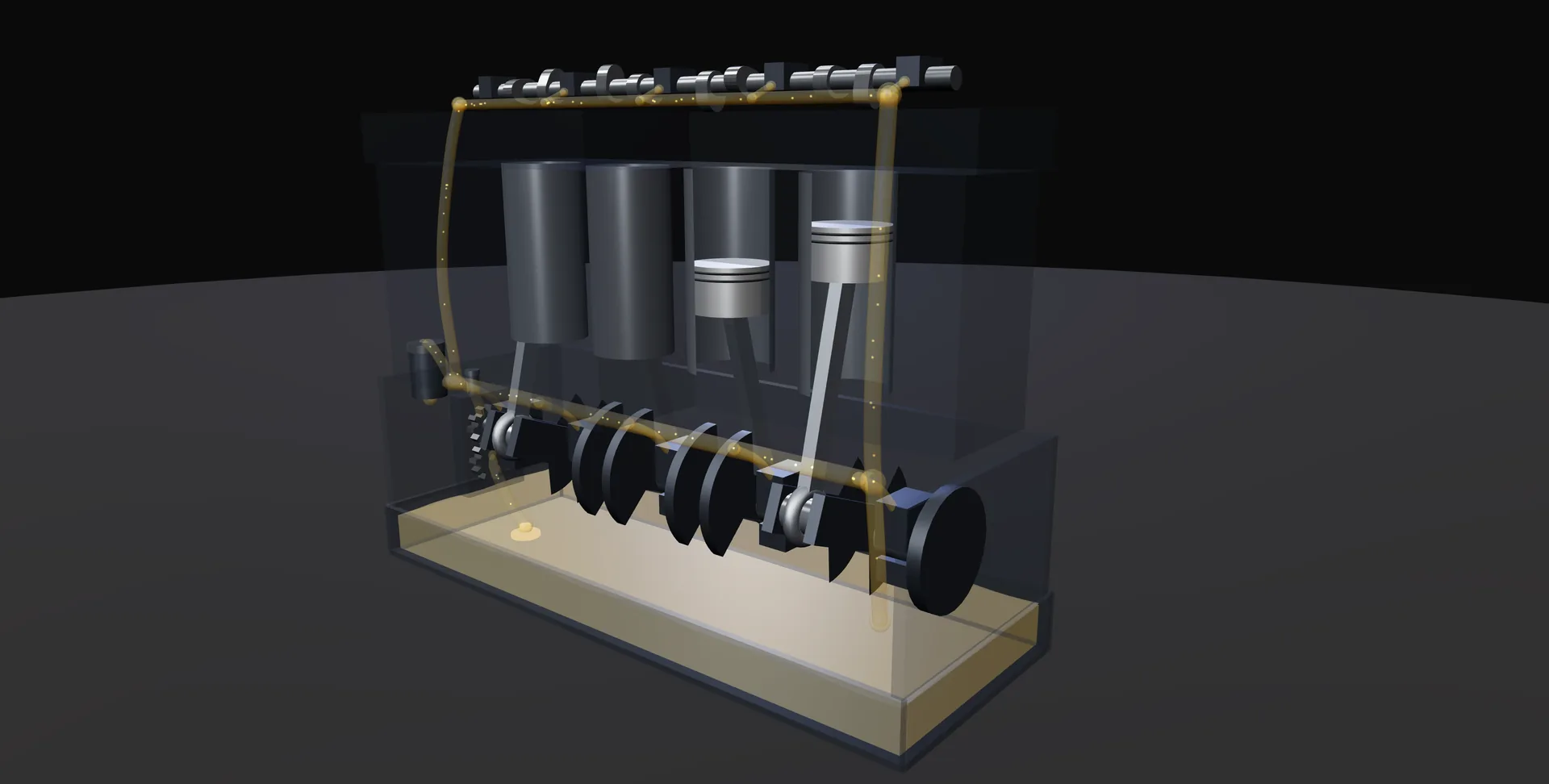
See when the EA288 oil pressure drops off
Rotate, adjust engine speed, compare stock against MMHP — in your browser, no sign-up.
Best experienced on a desktop or laptop — it runs on mobile, but space gets tight.
Installing the EA288 chain conversion: tools, time, workshop
The installation
- 2–3 hwhole conversion
- +½–1 hmore than a new belt
- In the kitspecial tools
- eGuideDIY or workshop
Steps: The sump and the timing belt come off (included in that time), the oil pump belt comes out; the belt sprocket comes off the crankshaft with the supplied puller, without removing the crankshaft bearing bracket. If you are having the timing belt replaced anyway, both jobs fit into one appointment.
Yourself or a workshop: either. The eGuide walks you through step by step with photos and is part of the package. Workshops that have not done the conversion yet need the eGuide, not extra tools. You do not need a different oil pump: the belt sprocket on the pump is swapped for the chain sprocket.
Threads: on some blocks the threads are not cut at the factory. Taps and a guide are in the kit, the eGuide shows the step.
Scope of delivery:
- eGuide online, German and English
- Crankshaft roller chain sprocket, hardened
- Special roller chain, hardened
- Oil pump roller chain sprocket, hardened
- Chain tensioner with guide rail (spring-loaded, one part)
- 4 special tools, including press-on tool and taps with guide
- Positioning tool for tensioner and guide rail
- Belt sprocket puller and crankshaft seal flange (cover with oil seal)
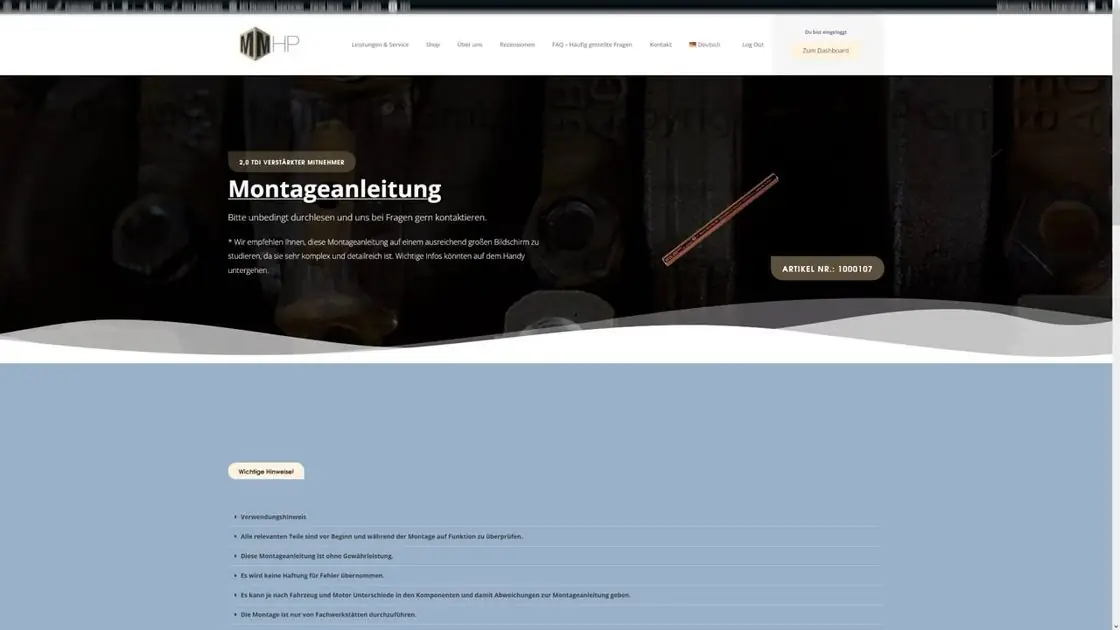
EA288 chain conversion, Gen 1 · €589 · kit with special tools and eGuide · ships the next working day
Go to the chain conversion in the shopEA288 chain conversion and oil pump belt: questions before you decide
Short answers, click a question
Does the chain conversion fit my EA288?
If your engine code is in the list above: yes. If it is missing, the solution finder checks it by HSN/TSN. Evo codes (05L oil pump on the upper sump section) do not fit.
Does the sump have to come off for the oil pump belt?
Yes, for a belt replacement as for the chain conversion, and the timing belt comes off too. The crankshaft seal flange is renewed at the same time (ContiTech bulletin 11/2024).
Can I install the EA288 chain conversion myself?
Yes, with the eGuide and the supplied tools. Mistakes almost always come from skipped steps, not from lack of skill; so follow the eGuide exactly.
Do I need a new oil pump for the conversion?
No. The belt sprocket on the existing pump is unbolted and replaced by the chain sprocket.
Oil pump belt snapped, what now?
Stop safely (the brake gets heavier), engine off and do not restart it; if the vacuum pump sits inside the oil pump, the brake servo loses its vacuum along with the oil pressure. Sump off, check strainer and pump, flush the circuit, new filter and oil: the debris then sits right up to the oil cooler and turbocharger, cleaning the strainer alone is not enough (wiki). If the engine is rebuilt, the chain goes in at the same time.
How long does the chain of the EA288 conversion last?
The chain conversion is designed for maintenance-free longevity; that is its purpose. In our tests over many years the chain showed no measurable wear, and we have never had to replace a worn part, not even after several hundred thousand kilometres. Should it happen against all expectations, you get the part from us free of charge.
This comes from the reinforced chain design and the spring-loaded tensioner that takes up the stretch of the bedding-in phase; without a tensioner the same chain would sometimes last only a few thousand kilometres (why every chain stretches). The precondition is healthy oil: persistently sooty oil wears chain and sprockets like any other part.
Does more oil pressure harm the EA288?
No. Every oil pump has a pressure relief valve, so the maximum pressure can never be exceeded, even with the conversion. The 38 percent more pump output works where the standard pump delivers too little: at idle and in the low to medium rev range, which is exactly the danger zone of the standard oil system. Isn't that much delivery too much? · Why we do not quote bar values.
Does VW still grant goodwill after the chain conversion?
That is the vehicle manufacturer's own decision, as with any non-OE part on the engine. For the conversion parts themselves, see the question on how long the chain lasts.
Is there a VW recall or service campaign for the oil pump belt?
None that we know of (as of 30 September 2026). You can check with a VW dealer using your VIN or in the KBA recall database.
How many MMHP chain conversions are in service?
Several thousand MMHP oil pump systems are running with customers all over the world; we do not publish numbers per engine. The 60,000+ customers above cover all MMHP products.
Can I run a different oil or extend the oil change interval after the conversion?
No. Oil specification and interval stay as prescribed by the manufacturer: the conversion removes the source of debris from the oil, not oil ageing (what actually helps, in the wiki).
How long does the oil pump belt last on the EA288?
There is no mileage figure: numbers such as 240,000 km for the oil pump belt do not come from VW, and the 210,000 km in the VW service schedule apply to the dry timing belt; VW calls the oil pump belt “maintenance-free”, which only means: no replacement date in the service schedule, no mileage (SSP 514). Figures from belt manufacturers apply to their own installation; individual reports range from cracks after a few years to unremarkable belts after 300,000 km (two belts, two worlds).
Why does the oil pump belt wear despite its low load?
The load is small, that is true. The damage does not come from load but from abrasion at the tooth mesh from day one and from aged oil attacking the rubber (why the belt degrades).
What damage to the EA288 oil pump belt is known?
As individual reports: cracked teeth, crumbs on the strainer, oil pressure faults, including on young vehicles; there are no statistics, not even our own. That little of it gets read is partly because a belt failure shows up as an oil pump, bearing or turbocharger failure once the cause has long since shredded (wiki, station 4).
Do regular oil changes help against the belt in oil?
Fresh oil of the right specification slows the chemical ageing of the rubber, and that is the only lever with proven effect. It does not slow the mechanical abrasion at the tooth mesh, and the pickup strainer is not cleaned during an oil change.
Does a 300,000 km rating apply to the EA288 oil pump belt?
No. Such figures apply to belt systems with a tensioner. The EA288 oil pump belt has no tensioner, it is tensioned only by the centre distance (SSP 514, quoted in the wiki).
The complete upgrade system with special tools and eGuide, €589 in the MMHP shop. Not for the EA288 evo; check the fit first by engine code or vehicle.
EA288 chain conversion in the shop