
EA189 Oil Pump Belt in Oil: Convert the Oil Pump to Chain Drive+35% or +116% pump output · no interval any more · only without balance shaft module
On the 1.6 and 2.0 TDI EA189 without balance shaft module, the oil pump belt runs in the engine oil and sheds material from day one.
from €329 (Stage 1) · Stage 2 €505 recommended · installation 2 to 3 hours · Does it fit my engine?
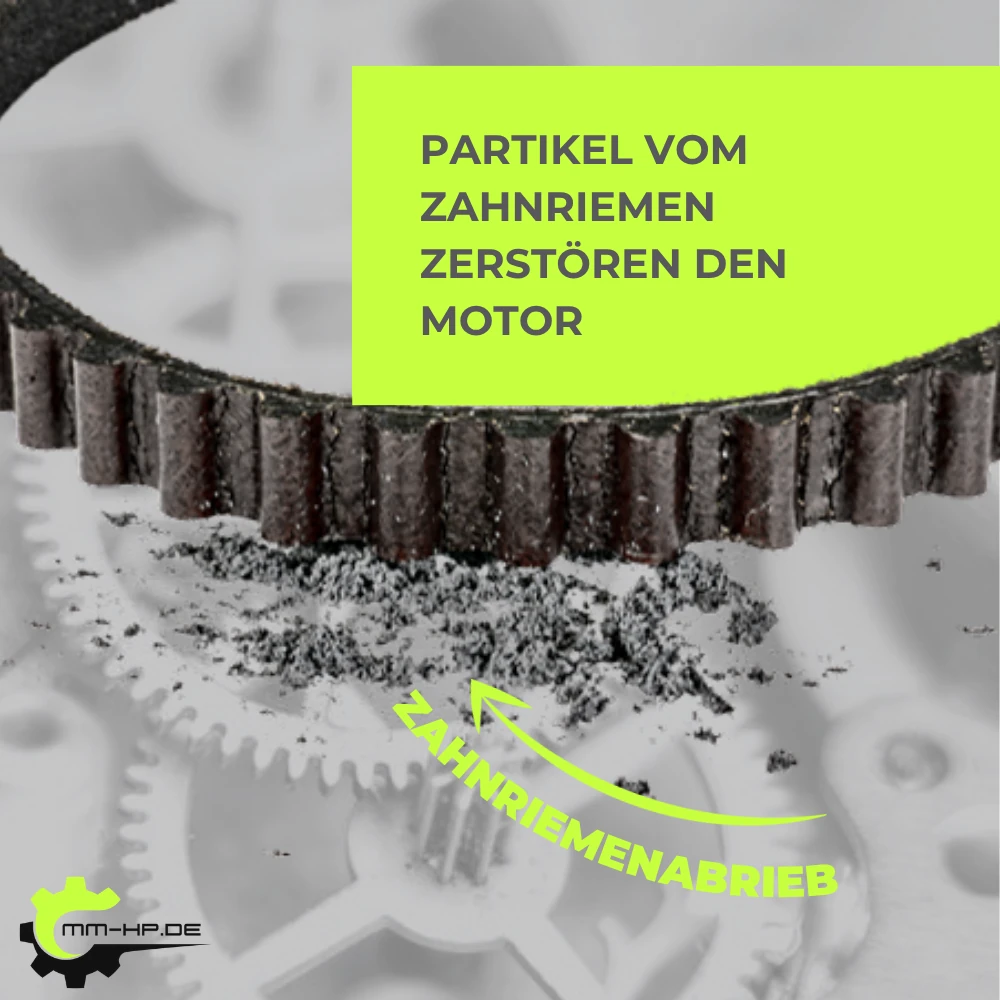
EA189 oil pump belt: the problem
Two belts, one in oil
The EA189 without balance shaft module has two toothed belts. The familiar one, the timing belt, drives the camshaft, dry. A second, short one sits on the crankshaft and drives the oil pump (VW 03L 115 264 A), and that one runs in the engine oil. There is no replacement interval for it; for the 1.6 TDI VW calls it maintenance-free in self-study programme 442, meaning: no replacement date in the service schedule. Why VW put the belt into the oil at all (less friction, less CO2) is explained in the wiki.
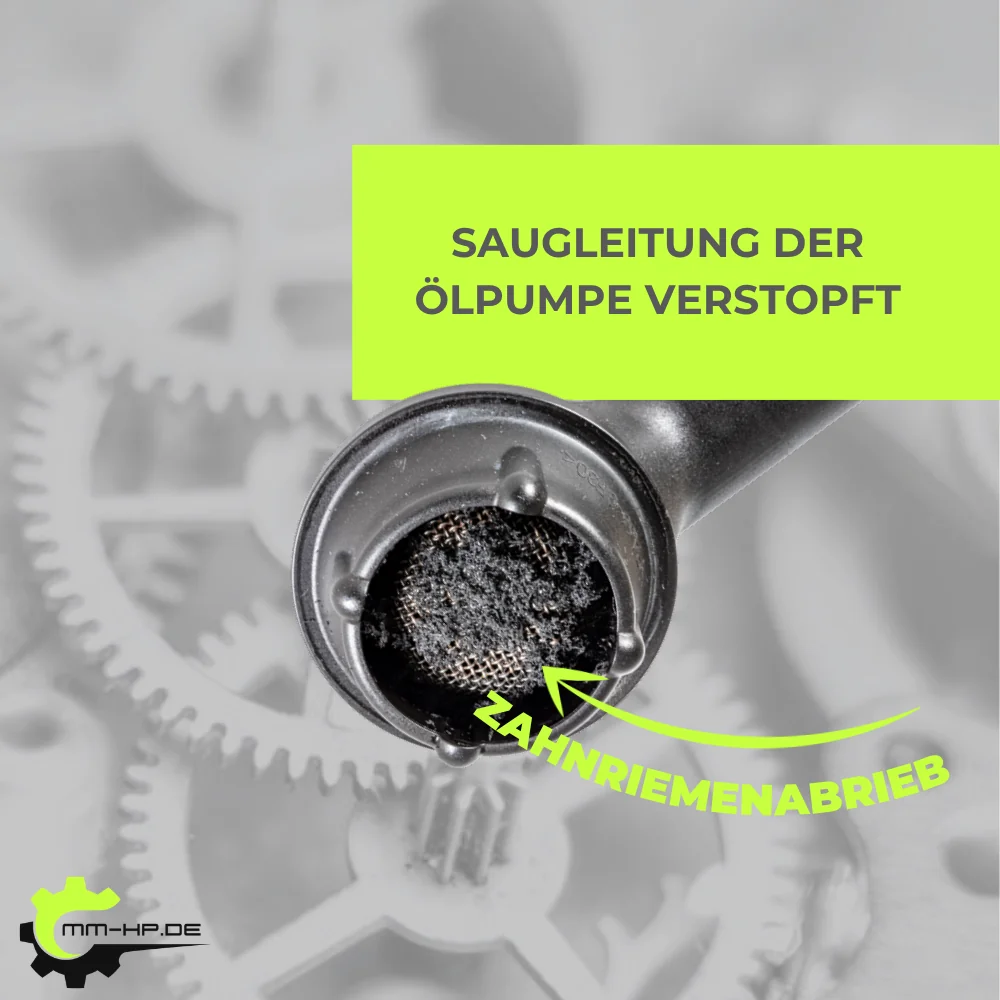
Oil attacks the rubber, and every belt running over two sprockets sheds debris. The particles end up on the oil pump pickup strainer and, as soon as the oil filter bypass valve opens, unfiltered throughout the engine: at the hydraulic tappets, bearings and turbocharger. Why that happens, station by station: MMHP wiki, timing belt in oil.
You will not notice it for a long time; the oil pressure warning stays off until the strainer is blocked far enough. What can still be checked (used oil, fault memory, strainer) is in the wiki chapter “How to tell”.
Does the chain conversion fit my EA189? All engines and vehicles
1.6 and 2.0 TDI EA189 without balance shaft module · 35 engine codes · 55 models
Fits EA189 engines without a balance shaft module (oil pump on the toothed belt), including the VW T5, Amarok and Crafter. Does not fit: EA189 with a balance shaft module (e.g. CFCA, CFFB, CBAB, CCHA; for those: conversion kit) or any EA288 (EA288 upgrade). Engine code: registration document, field D.2; by HSN/TSN the solution finder checks it.
55 models · 4 makes · 35 engine codes
A model can be built with different engines, including ones with a balance shaft module, which has its own solution. Only the engine code tells whether the chain conversion fits.
Volkswagen32 models
| Model | Built | Power |
|---|---|---|
| AMAROK (2HA, 2HB, S1B, S6B, S7A, S7B) (2.0) | 2010–present | 122/140/163/180 PS |
| AMAROK pickup/chassis cab (S1B) (2.0) | 2011–present | 140 PS |
| BEETLE (5C1, 5C2) (1.6) | 2011–2016 | 105 PS |
| BEETLE Cabriolet (5C7, 5C8) (1.6) | 2011–2016 | 105 PS |
| CADDY III panel van (2KA, 2KH, 2CA, 2CH) (1.6 · 2.0) | 2010–2015 | 75/85/102/110/140/170 PS |
| CADDY III passenger van (2KB, 2KJ, 2CB, 2CJ) (1.6 · 2.0) | 2010–2015 | 75/102/110/140/170 PS |
| CADDY IV panel van (SAA, SAH) (1.6 · 2.0) | 2015–present | 75/102/110/140 PS |
| CADDY IV passenger van (SAB, SAJ) (1.6 · 2.0) | 2015–present | 75/102/110/140 PS |
| CRAFTER 30-35 Bus (2E_) (2.0) | 2011–2016 | 109/114/136/163 PS |
| CRAFTER 30-50 panel van (2E_) (2.0) | 2011–2016 | 109/114/136/142/163 PS |
| CRAFTER 30-50 pickup/chassis cab (2F_) (2.0) | 2011–2016 | 109/114/136/142/163 PS |
| GOLF PLUS (5M1, 521) (1.6 · 2.0) | 2005–2013 | 90/105/110/136/140 PS |
| GOLF VI (5K1) (1.6 · 2.0) | 2008–2012 | 90/105/110 PS |
| GOLF VI Cabriolet (517) (1.6 · 2.0) | 2011–2016 | 105/140 PS |
| GOLF VI Variant (AJ5) (1.6 · 2.0) | 2009–2013 | 90/105/110/140 PS |
| JETTA III (1K2) (1.6) | 2009–2010 | 90/105 PS |
| JETTA IV (162, 163, AV3, AV2) (1.6 · 2.0) | 2010–present | 105/110/140 PS |
| MULTIVAN T5 (7HM, 7HN, 7HF, 7EF, 7EM, 7EN) (2.0) | 2009–2015 | 84/102/136/140 PS |
| MULTIVAN T6 (SGF, SGM, SGN) (2.0) | 2015–present | 102/140 PS |
| PASSAT (362) (1.6) | 2010–2014 | 105 PS |
| PASSAT (3C2) (1.6) | 2009–2010 | 105 PS |
| PASSAT Variant (365) (1.6) | 2010–2014 | 105 PS |
| PASSAT Variant (3C5) (1.6) | 2009–2010 | 105 PS |
| POLO (6R1, 6C1) (1.6) | 2009–present | 75/90/105 PS |
| SCIROCCO (137, 138) (2.0) | 2008–2017 | 136/140 PS |
| TOURAN (1T3) (1.6 · 2.0) | 2010–2015 | 90/105/110/140/170/177 PS |
| TRANSPORTER T5 Bus (7HB, 7HJ, 7EB, 7EJ, 7EF, 7EG, 7HF, 7EC) (2.0) | 2009–2015 | 84/102/136/140 PS |
| TRANSPORTER T5 panel van (7HA, 7HH, 7EA, 7EH) (2.0) | 2009–2015 | 84/102/136/140 PS |
| TRANSPORTER T5 pickup/chassis cab (7JD, 7JE, 7JL, 7JY, 7JZ (2.0) | 2009–2015 | 84/102/114/136/140 PS |
| TRANSPORTER T6 Bus (SGB, SGG, SGJ) (2.0) | 2015–present | 84/102/140 PS |
| TRANSPORTER T6 panel van (SGA, SGH) (2.0) | 2015–present | 84/102/140 PS |
| TRANSPORTER T6 pickup/chassis cab (SFD, SFE, SFL, SFZ) (2.0) | 2015–present | 84/102/140 PS |
Audi5 models
| Model | Built | Power |
|---|---|---|
| A1 (8X1, 8XK) (1.6 · 2.0) | 2010–2015 | 90/105/136/143 PS |
| A1 Sportback (8XA, 8XF) (1.6 · 2.0) | 2011–2015 | 90/105/136/143 PS |
| A3 (8P1) (1.6) | 2009–2012 | 90/105 PS |
| A3 Cabriolet (8P7) (1.6) | 2009–2013 | 105 PS |
| A3 Sportback (8PA) (1.6) | 2009–2013 | 90/105 PS |
Seat7 models
| Model | Built | Power |
|---|---|---|
| ALTEA (5P1) (1.6 · 2.0) | 2004–present | 90/105/140 PS |
| ALTEA XL (5P5, 5P8) (1.6 · 2.0) | 2006–present | 90/105/140/170 PS |
| IBIZA IV (6J5, 6P1) (1.6 · 2.0) | 2009–present | 90/105/143 PS |
| IBIZA IV SPORTCOUPE (6J1, 6P5) (1.6 · 2.0) | 2009–present | 90/105/143 PS |
| IBIZA IV ST (6J8, 6P8) (1.6) | 2010–present | 90/105 PS |
| LEON (1P1) (1.6 · 2.0) | 2005–2012 | 90/105/140/170 PS |
| TOLEDO IV (KG3) (1.6) | 2012–2015 | 90/105 PS |
Škoda11 models
| Model | Built | Power |
|---|---|---|
| FABIA II (542) (1.6) | 2010–2014 | 75/90/105 PS |
| FABIA II Combi (545) (1.6) | 2010–2014 | 75/90/105 PS |
| OCTAVIA II (1Z3) (1.6 · 2.0) | 2004–2013 | 105/110/140 PS |
| OCTAVIA II Combi (1Z5) (1.6 · 2.0) | 2004–2013 | 105/110/140 PS |
| RAPID (NH3) (1.6) | 2012–present | 90/105 PS |
| RAPID Spaceback (NH1) (1.6) | 2012–present | 90/105 PS |
| ROOMSTER (5J) (1.6) | 2010–2015 | 90/105 PS |
| ROOMSTER Praktik (5J) (1.6) | 2010–2015 | 90 PS |
| SUPERB II (3T4) (1.6) | 2010–2015 | 105 PS |
| SUPERB II estate (3T5) (1.6) | 2010–2015 | 105 PS |
| YETI (5L) (1.6 · 2.0) | 2009–2017 | 105/110/140/170 PS |
Engine codes the conversion fits35 codes
CAAA CAAB CAAC CAAD CAAE CAYA CAYB CAYC CAYD CAYE CBDB CBDC CDBA CDCA CFHA CFHB CFHC CFHD CFHE CFHF CFJA CFJB CKTB CKTC CKUB CKUC CLCA CLNA CNEA CNFA CNFB CSLA CSLB CSLC CSNA
As of 23 October 2026, from our fitment database (PS = metric horsepower). The shop verifies the binding fitment with your vehicle. More depth in the MMHP wiki “Timing belt in oil”: affected engines · find your engine code.
EA189 with or without balance shaft module?
Which oil pump does my engine have
The EA189 comes with two different oil pump drives, and they are often mixed up, including in search answers. Which one is fitted depends on the engine code, not on the year of manufacture.
Without balance shaft module a toothed belt in the oil drives the oil pump. This affects all 1.6 TDI in our fitment list and some of the 2.0 TDI, including in the T5, Amarok and Crafter. The chain conversion on this page is for this design.
With balance shaft module (2.0 TDI only) the oil pump sits in the module under the crankshaft and runs via a hexagon shaft; there is no belt in the oil there, the weak point is the drive pin on that shaft. For that there is the reinforced drive pin or the conversion kit without balance shaft module.
If your car has a newer 1.6 or 2.0 TDI of the EA288 series, that is another engine again: EA288 chain conversion.
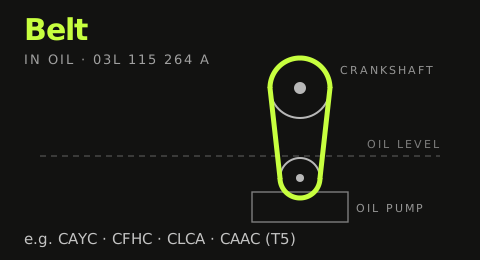
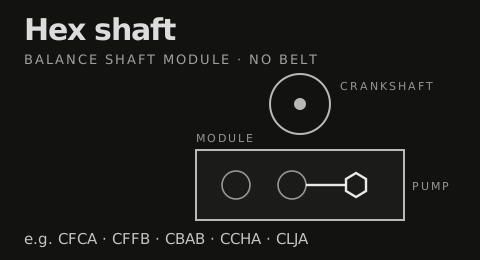
| Feature | EA189 without module from the factory | EA189 with module |
|---|---|---|
| Oil pump drive | Toothed belt in oil (03L 115 264 A) | Gear and hexagon shaft in the module |
| Displacement | 1.6 and 2.0 TDI | 2.0 TDI only |
| Weak point | Belt debris, no replacement interval | Hexagon drive pin wears |
| Engine codes (examples) | CAYC · CFHC · CLCA · CAAC · CKTB · CSLA | CFCA · CFFB · CBAB · CCHA · CFGB · CLJA |
| MMHP solution | Chain conversion (this page) | Drive pin or conversion kit |
Source: MMHP fitment database (shop vehicle lists, as of 30 September 2026); the 1.6 TDI appears there only without the module from the factory.
Replace the belt or convert: what the EA189 costs
The numbers
VW specifies no replacement interval (why, in the wiki). A new belt and the chain conversion need the same access: sump and timing belt off, oil pump belt out, plus oil and filter for both. The difference is the part, the time at the open engine and what you are left with:
| Option | Parts | Labour | What remains |
|---|---|---|---|
| Do nothing, look after the oil | €0 today | none | The debris keeps coming, the condition stays unknown. By the time the oil pressure warning comes on, the damage is usually done: turbocharger, bearings, in the worst case the engine. |
| Replace the belt | Belt 03L 115 264 A, aftermarket around €13–15 (retail, 1 Oct 2026) | Sump and timing belt off, belt out; your workshop’s hourly rate | Debris from day one, oil pressure as low as from the factory. The next replacement comes without a fixed date, each time with the same work. |
| Chain Stage 1 (+35%) | €329 kit with MMHP oil pump, special tools and eGuide (shop price, synced hourly) | the same access; conversion 2 to 3 h following the eGuide, about half an hour to an hour more than “replace the belt” (MMHP experience) | No more rubber in the oil, no interval. At idle it sits only just above the danger limit; better suited to engines in as-new condition. |
| Chain Stage 2 (+116%) Recommended if the engine is to run for a long time | €505 kit with larger MMHP oil pump (shop price, synced hourly) | as Stage 1 | No more rubber in the oil, no interval, a reserve above the danger limit throughout. Converted once, maintenance-free with no mileage limit. |
EA189 timing belt service: replace the oil pump belt too, or convert to chain?
The decision
The question usually comes up when the timing belt is due and the workshop offers to do the oil pump belt as well, on the CFHC or CAYC just as in the T5. It is a separate part (VW 03L 115 264 A) and usually not included in the standard timing belt kit; ask your workshop. Replacing it needs the timing belt and the sump off. During a timing belt service the timing belt is off anyway, which leaves the sump. That makes this appointment the cheapest moment for either job:
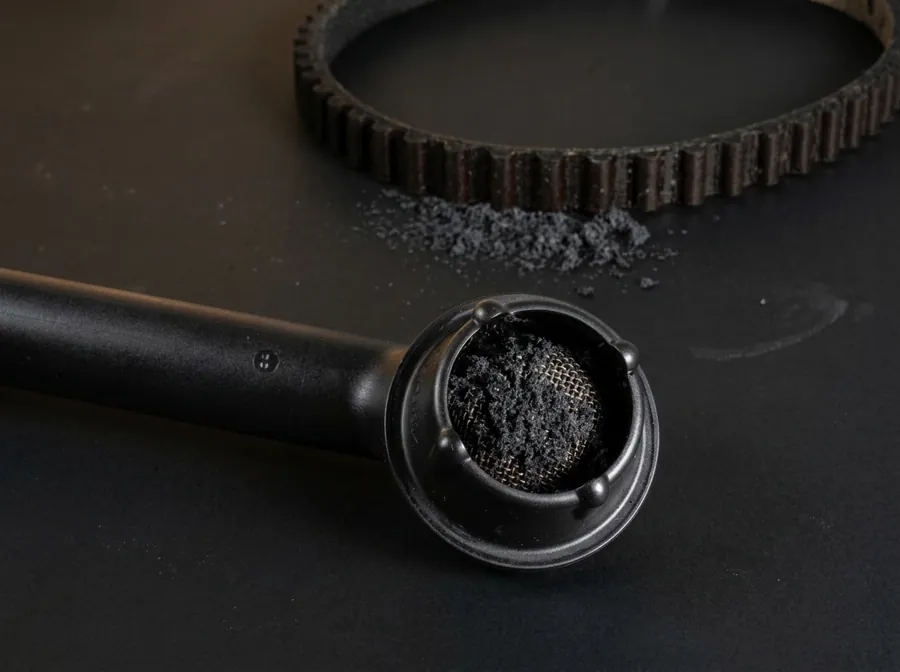
Right for you if you will part with the car soon.
What remains: condition unknown, the wear keeps going; there is no interval to go by (why, in the wiki). How the strainer clogs is shown in the animation in the wiki.
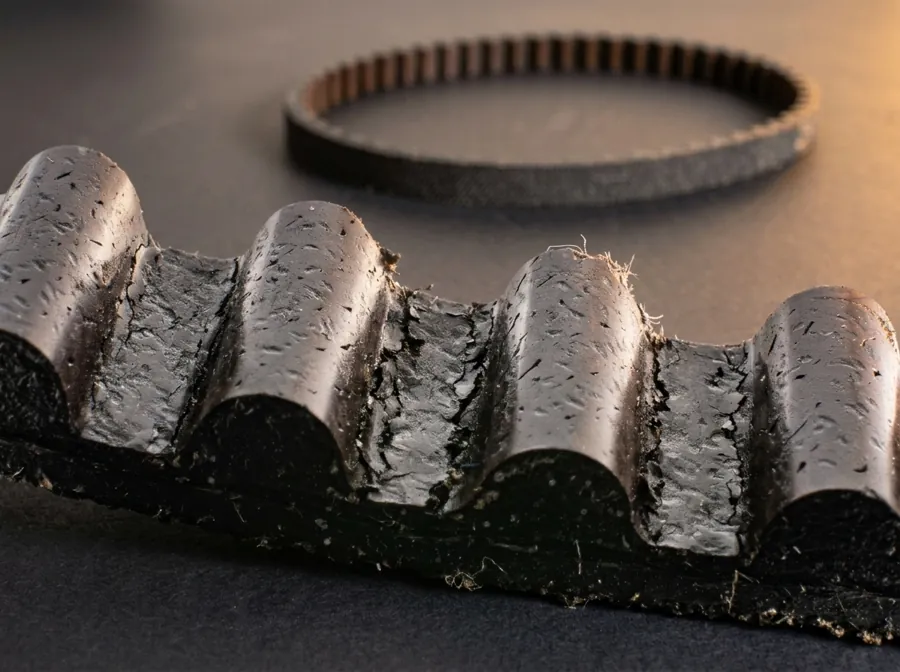
Labour: sump and timing belt off, again at every belt replacement
Right for you if you are prepared to have the belt replaced again and again without knowing when it is due.
What remains: the new belt also sheds debris into the oil from day one, the particles keep travelling through the circuit, and the oil pressure stays as low as from the factory. There is no replacement date, so the work comes back: several hours each time, around €500 of workshop labour per replacement (example, depends on the hourly rate).
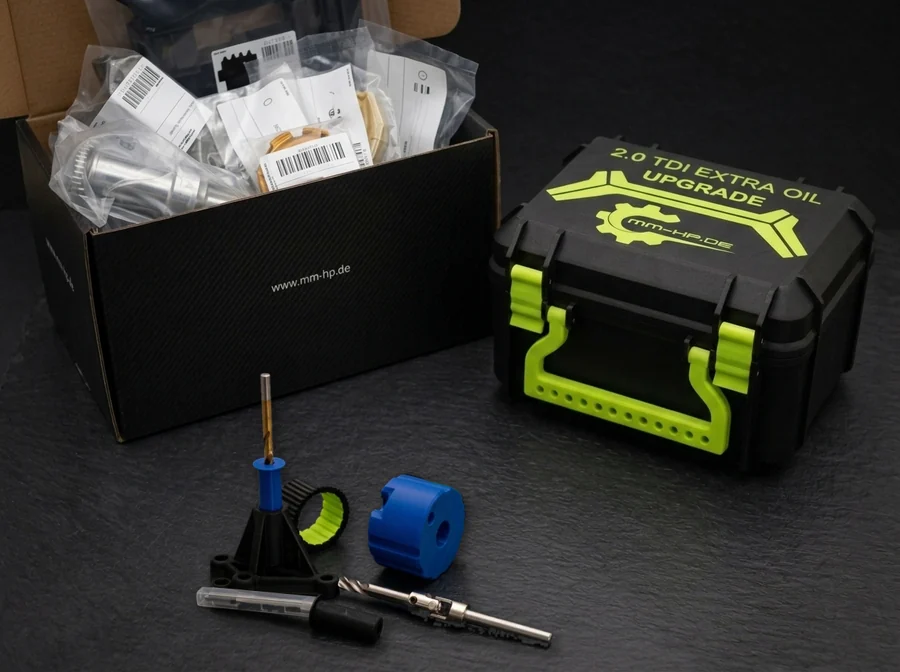
Access: the same, about ½ to 1 h more than “replace the belt”; new MMHP oil pump is in the kit
Right for you if you want to keep the engine and answer the question only once.
What remains: no rubber in the oil, 35 or 116 % more delivery, maintenance-free with no mileage limit: even systems with several hundred thousand kilometres have shown no wear. The chain runs with a spring-loaded tensioner (why). Ships the next working day, so order before the appointment (installation).
Chain conversion in the shopWhy the conversion pays off: you pay for the bulk of the work, sump and timing belt off, again at every oil pump belt replacement. At the same appointment the conversion costs about half an hour to an hour more and saves every further replacement; in our experience it has paid for itself after about two avoided belt replacements.
Timing belt already done, oil pump belt never mentioned? The conversion is still worth it, but it costs the labour a second time: sump and timing belt have to come off again (whether the freshly fitted timing belt can be refitted is for your workshop to decide according to VW specifications: a new or still young belt can usually go back on, beyond a certain mileage it pays to replace it as well). With the sump off, the strainer shows the findings, and the chain goes in during the same job.
What we see on EA189 oil pump belts: debris in the oil, porous and cracked teeth, crumbs on the pickup strainer, a blocked pickup pipe (pictures in section 01). These are individual cases, there are no statistics: it does not happen to everyone, but it does happen, and whoever leaves the belt in carries that risk themselves.
Independent of the belt: the standard pump delivers too little oil pressure at hot idle and low revs, and the usual workshop gauges of accuracy class 1.6 give no reliable reading below 1 bar, so workshops rarely notice it (oil pressure gauges · why we quote no bar values). The chain conversion with the MMHP oil pump adds delivery exactly there.
Converting the oil pump to chain drive: Stage 1 or Stage 2 and what we measured
The solution
The conversion removes the oil pump belt, belt sprockets and standard oil pump and builds up anew from the crankshaft journal: MMHP oil pump, hardened roller chain, spring-loaded chain tensioner with guide rail. The oil sump stays the original one.
Stage 1 or Stage 2. Stage 1 delivers 35 percent more than stock, Stage 2 with a larger pump 116 percent more. We recommend Stage 2: Stage 1 sits just above the danger limit at idle and, depending on engine wear, can fall below it; it suits engines in as-new condition better. T5, T6, Amarok and Crafter come with Stage 2 only. Why we state this in percent rather than in bar: oil pressure is not a fixed pump value, every engine is unique.
More delivery also cools. More oil through the standard oil cooler lowers the oil temperature, by 10 to 15 degrees on average as measured on customer vehicles, and the jets cool the pistons earlier and harder; that protects the cylinder walls and slows the coking of the piston rings that drives oil consumption and blow-by. Derived in the wiki: oil temperature · oil consumption and blow-by.
What we measured. We are developers, not rebuilders. There was no oil pressure measuring equipment that satisfied us, so we built our own, hardware and software, and logged thousands of hours in customer vehicles: real pressures, real temperatures, real engine speeds. Those measurement series are the source of the VHFI, our own index; the curve below shows it schematically. How the VHFI is derived · Measurement and test rigs.
Stage 1 or Stage 2: Stage 1 (+35%) sits right at the boundary; depending on the engine's wear and manufacturing tolerances, it can drop into the danger zone. Stage 2 (+116%) keeps a reserve throughout, which is why we recommend it. You choose stage 2 in the shop within the same product (performance option).
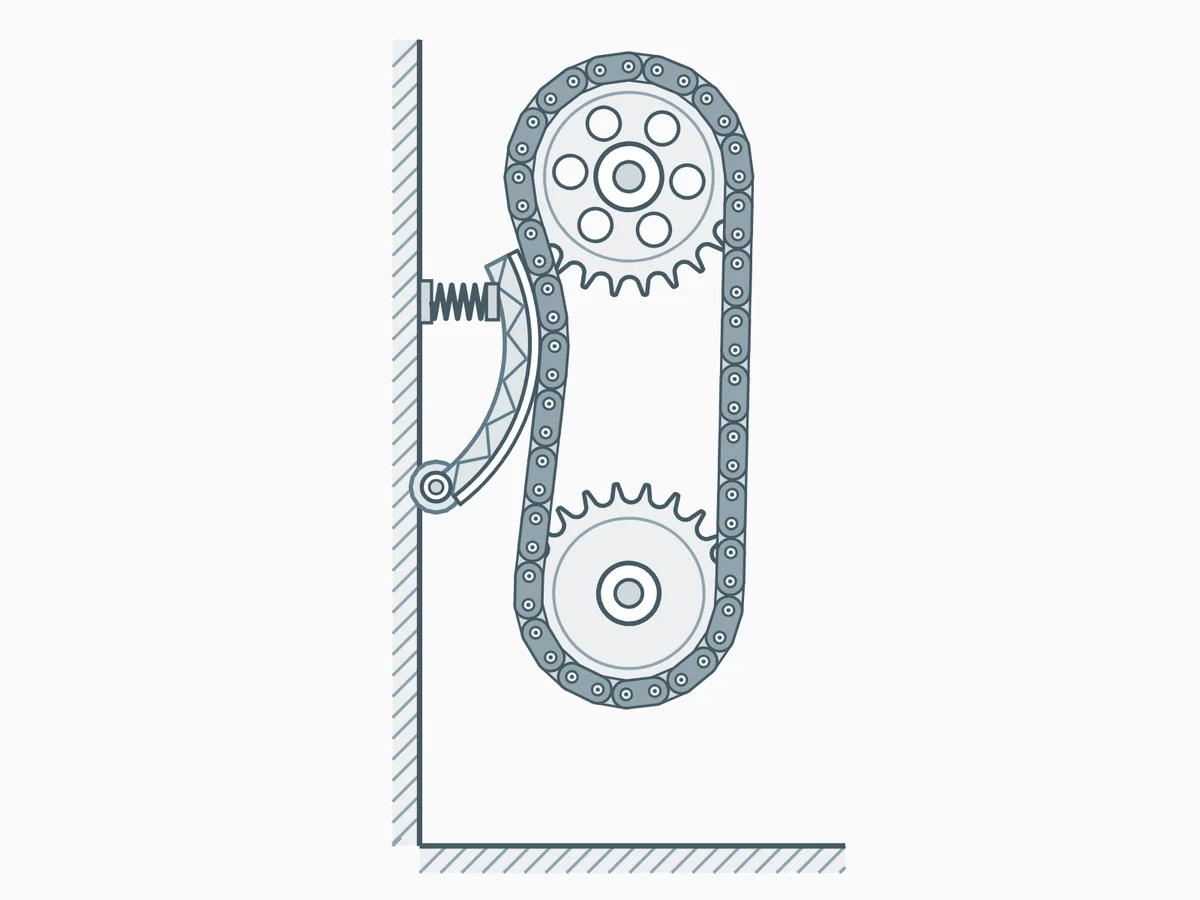
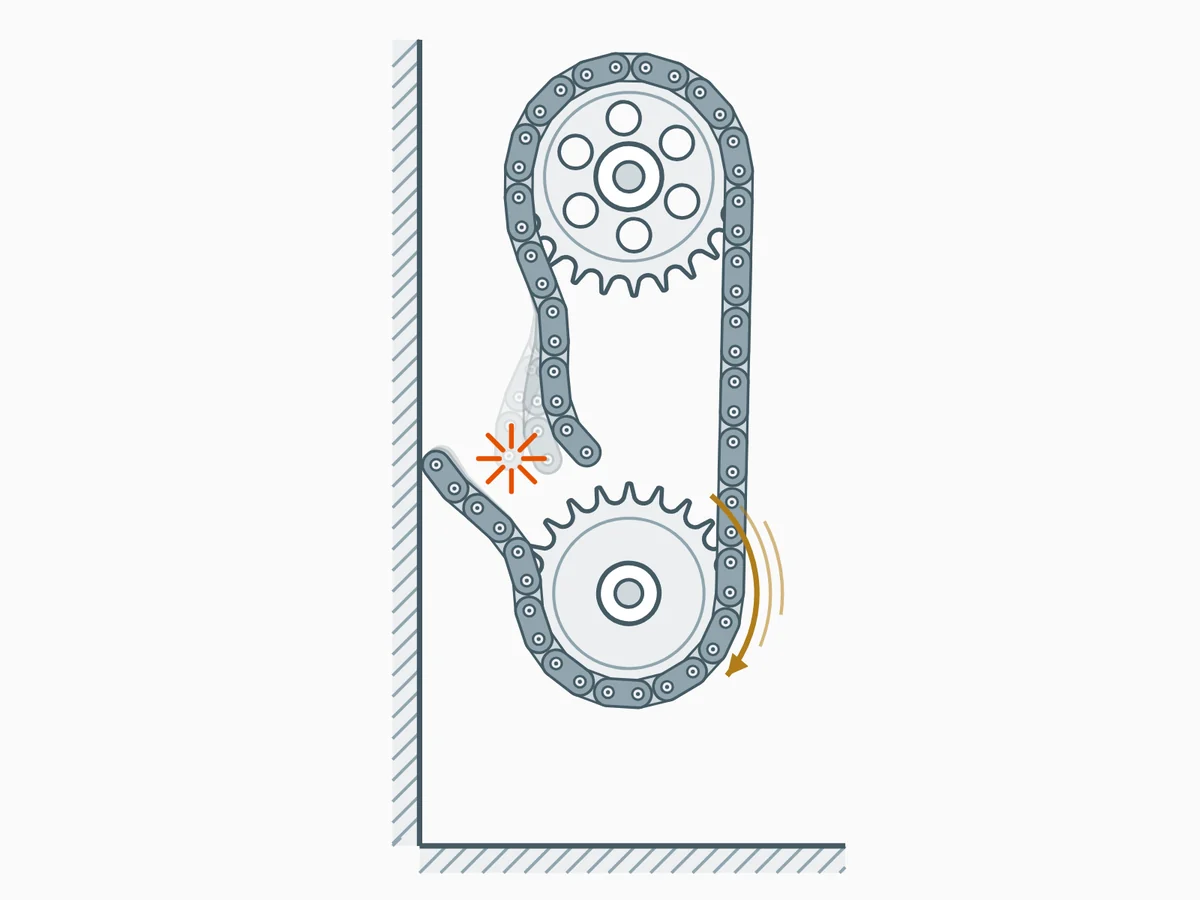 Without tensioner: the chain breaks
 With tensioner and guide rail
A chain without a tensioner gets looser with every kilometre
Even a little stretch makes the slack side whip sideways; depending on engine speed a wave builds up, wear increases and the stretch keeps growing. In the end the chain jumps a tooth or breaks, and the oil pump stops while the engine keeps running.
That is why the MMHP conversion has a spring-loaded tensioner with a guide rail in the right place. It takes up the stretch and keeps the chain steady for its whole life.
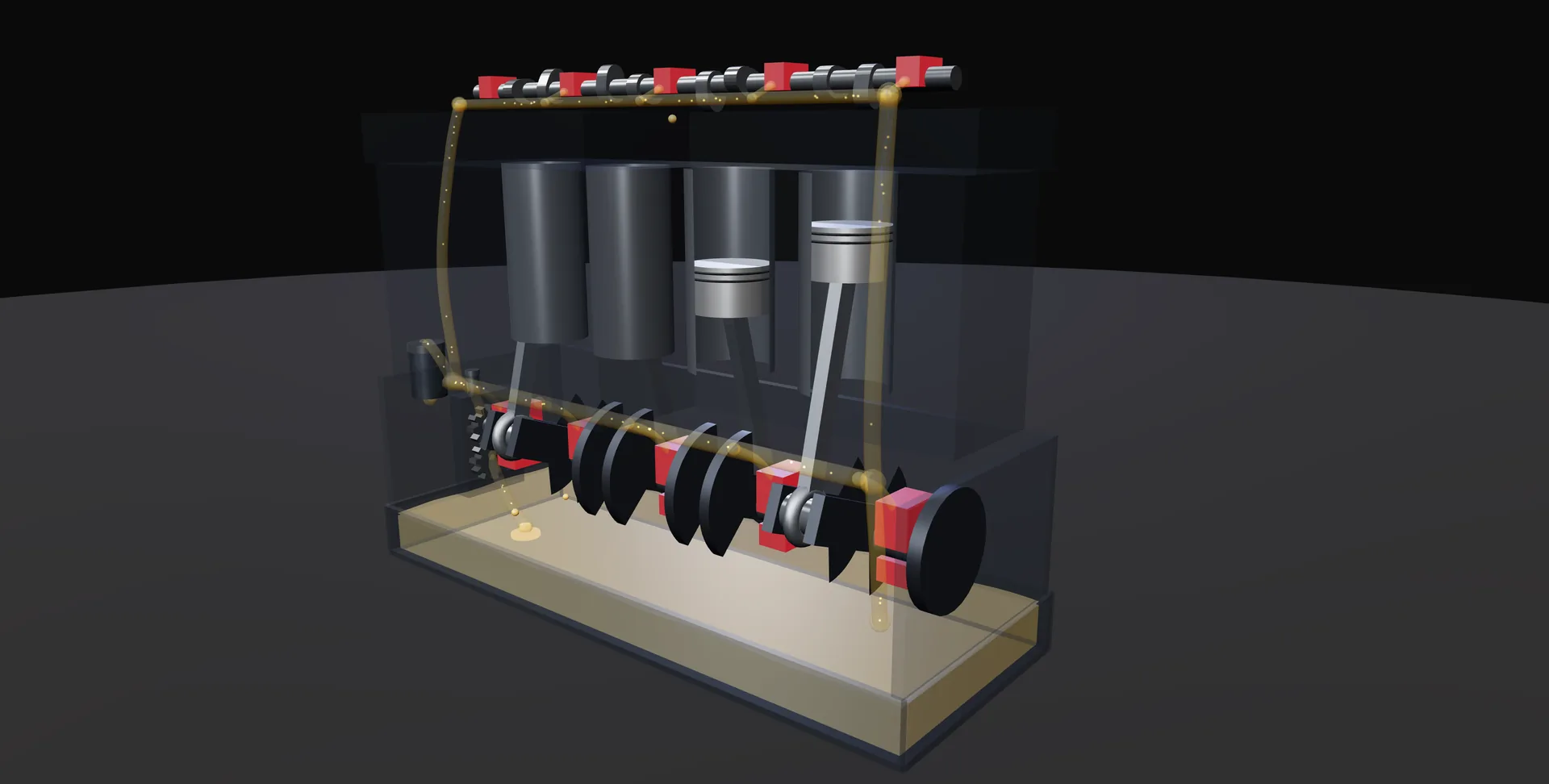
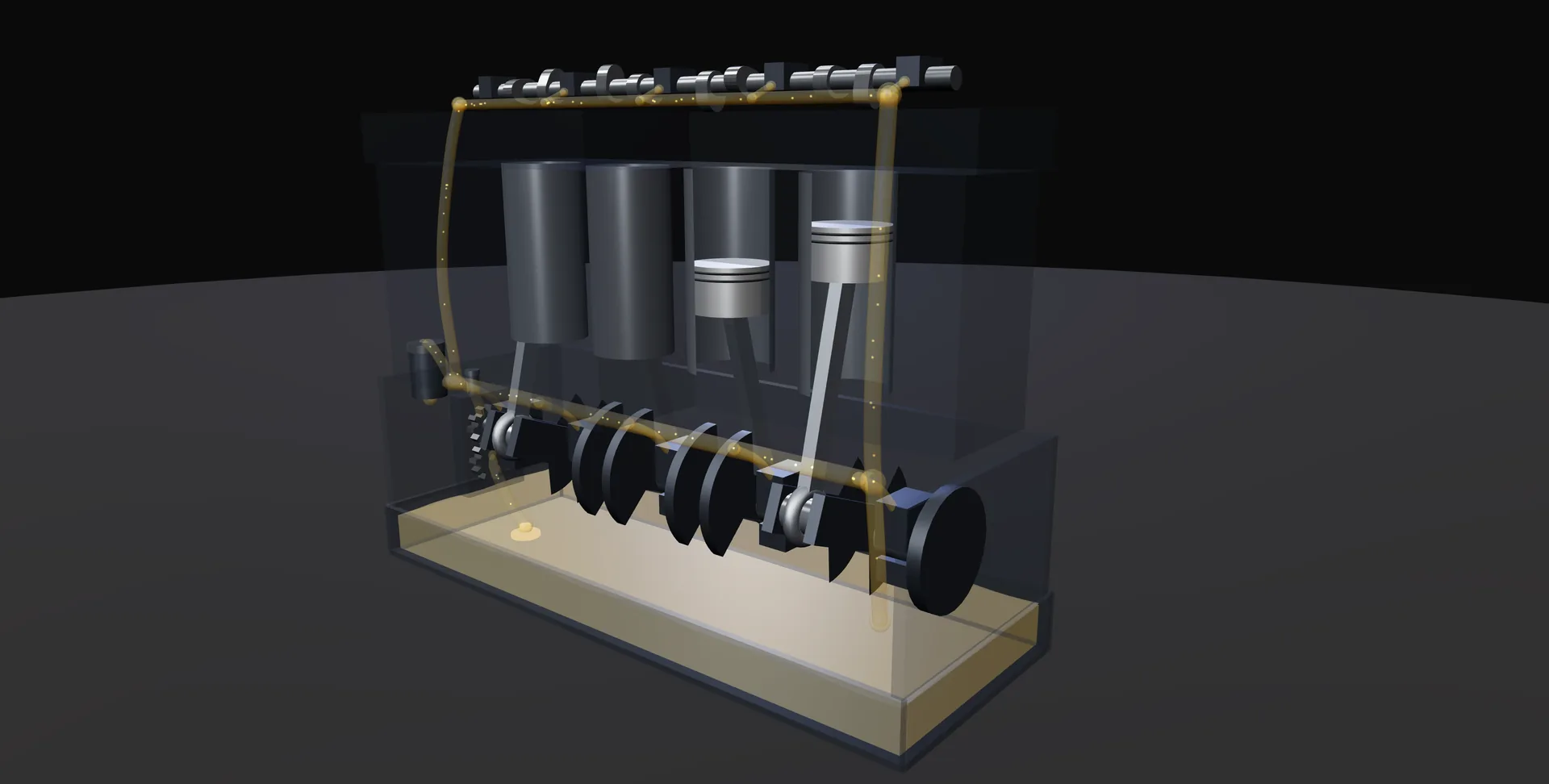
See when the EA189 oil pressure drops off
Rotate, adjust engine speed, compare stock against MMHP — in your browser, no sign-up.
Best experienced on a desktop or laptop — it runs on mobile, but space gets tight.
Installing the EA189 chain conversion: tools, time, workshop
The installation
Time: 2 to 3 hours following the eGuide, about half an hour to an hour more than a plain belt replacement. The sump and the timing belt come off (included in that time), the oil pump belt, belt sprockets and standard oil pump come out; the supplied puller takes the belt sprocket off the crankshaft without damage. If you are having the timing belt replaced anyway, both jobs fit into one appointment.
Yourself or a workshop: either. The eGuide walks you through step by step with photos, is matched to your engine type and is part of the package. Usual workshop skills are assumed: timing belt, sump, crankshaft seal, oil pump, cutting threads.
Choose the variant: in the shop you select transverse engine, longitudinal engine, T5 or Amarok/Crafter and the stage.
Scope of delivery:
- eGuide online, German and English
- MMHP high-performance oil pump (Stage 1 or 2)
- Special roller chain, hardened
- Special roller chain sprocket, hardened
- Chain tensioner with guide rail (one assembly)
- 6 assembly tools, including press-on tool, puller for the old belt sprocket and positioning tool for the guide rail
EA189 chain conversion · Stage 2 €505, Stage 1 €329 · kit with MMHP oil pump, special tools and eGuide · ships the next working day
Go to the chain conversion in the shopEA189 chain conversion and oil pump belt: questions before you decide
Short answers, click a question
Does the chain conversion fit my EA189?
If your engine code is in the list above: yes. If it is missing, the solution finder checks it by HSN/TSN. Engine codes with a balance shaft module (e.g. CFCA, CFFB) do not fit, the other solution applies there.
Does every EA189 have a toothed belt on the oil pump?
No. Only the EA189 without balance shaft module. With the module a hexagon shaft drives the oil pump, and no belt runs in the oil there (difference in section 03).
Does the sump have to come off for the oil pump belt?
Yes, for a belt replacement as for the chain conversion, and the timing belt comes off too.
Can I install the EA189 chain conversion myself?
Yes, with the eGuide and the supplied tools. Mistakes mostly happen where a step is missing or not known exactly. That is why the eGuide is part of the package: it walks you through the conversion step by step so that it goes without surprises.
Stage 1 or Stage 2: which oil pump do I need?
We recommend Stage 2 (+116 %). Stage 1 (+35 %) sits just above the danger limit at idle and suits engines in as-new condition better. For T5, T6, Amarok and Crafter there is only Stage 2.
Oil pump belt snapped, what now?
Stop safely and do not restart the engine. Sump off, check strainer and pump, flush the circuit, new filter and oil: the debris then sits right up to the oil cooler and turbocharger, cleaning the strainer alone is not enough (wiki). If the engine is rebuilt, the chain goes in at the same time.
How long does the chain of the EA189 conversion last?
The chain conversion is designed for maintenance-free longevity; that is its purpose. In our tests over many years the chain showed no measurable wear, and we have never had to replace a worn part, not even after several hundred thousand kilometres. Should it happen against all expectations, you get the part from us free of charge.
This comes from the reinforced chain design and the spring-loaded tensioner that takes up the stretch of the bedding-in phase; without a tensioner the same chain would sometimes last only a few thousand kilometres (why every chain stretches). The precondition is healthy oil: persistently sooty oil wears chain and sprockets like any other part.
Does more oil pressure harm the EA189?
No. Every oil pump has a pressure relief valve, so the maximum pressure can never be exceeded, even with the conversion. The higher delivery works where the standard pump delivers too little: at idle and in the low to medium rev range. Isn't that much delivery too much?
Does VW still grant goodwill after the chain conversion?
That is the vehicle manufacturer's own decision, as with any non-OE part on the engine.
Is there a VW recall or service campaign for the oil pump belt?
None that we know of (as of 1 October 2026). You can check with a VW dealer using your VIN or in the KBA recall database.
How many MMHP chain conversions are in service?
Several thousand MMHP oil pump systems are running with customers all over the world; we do not publish numbers per engine. The 60,000+ customers above cover all MMHP products.
Can I run a different oil or extend the oil change interval after the conversion?
No. Oil specification and interval stay as prescribed by the manufacturer: the conversion removes the source of debris from the oil, not oil ageing (what actually helps, in the wiki).
How long does the oil pump belt last on the EA189?
There is no mileage figure: the replacement interval in the service schedule applies to the dry timing belt; for the 1.6 TDI VW calls the oil pump belt “maintenance-free” and means only: no replacement date in the service schedule, no mileage figure (SSP 442). How long an individual belt lasts depends on oil, driving profile and running time and cannot be seen without the sump off (two belts, two worlds).
Why does the oil pump belt wear despite its low load?
The load is small, that is true. The damage does not come from load but from abrasion at the tooth mesh from day one and from aged oil attacking the rubber (why the belt degrades).
What damage to the EA189 oil pump belt is known?
As individual cases: porous and cracked teeth, crumbs on the strainer, oil pressure warning; there are no statistics. That little of it gets read is partly because a belt failure often shows up as an oil pump, bearing or turbocharger failure once the cause has long since shredded (wiki, station 4).
The oil strainer is clear: is everything fine then?
Not necessarily. A clear strainer says nothing about the debris that passed through and sits in the filter or, with the bypass valve open, in the circuit (wiki, station 3).
Can you see the oil pump belt at an oil change?
No. It runs in the crankcase behind the sump; its condition only shows with the sump off (why you cannot check it).
Do regular oil changes help against the belt in oil?
Fresh oil of the right specification slows the chemical ageing of the rubber, and that is the only lever with proven effect. It does not slow the mechanical abrasion at the tooth mesh, and the pickup strainer is not cleaned during an oil change.
Does a 300,000 km rating apply to the EA189 oil pump belt?
No. Such figures apply to belt systems with a tensioner. The oil pump belt has no tensioner. For the 1.6 TDI VW describes it as a maintenance-free belt without a tensioner (SSP 442); it is tensioned only by the centre distance (wiki).
The complete upgrade system with MMHP oil pump, special tools and eGuide, Stage 2 (recommended) €505, Stage 1 €329, in the MMHP shop. Not for the EA189 with balance shaft module.
EA189 chain conversion in the shop