Permanently remove the 2.0 TDI balance shaft moduleOil pump driven directly by chain · +35 % or +116 % flow rate · no more drive pin
Inside the 2.0 TDI balance shaft module, a small hex drive pin turns the oil pump. Once it wears, the engine loses oil pressure. With the conversion kit the whole module comes out, and a chain drives a larger oil pump directly.
Stage 2, recommended: from €468 · Stage 1: from €299 · Fitting 2–4 h (typical) · T5 with CFCA: Stage 2 only
Check fit in the shopThe oil pump drive in the 2.0 TDI is under-engineered from the factory.
That is our claim, on our own site. It does not stand alone.

By the time the red light comes on, the damage has
already been done.
VW and Skoda confirmed case numbers
in the three-digit range
to the editorial team, and Audi ran
service campaign 13D7 in response.
- Report
- “VW-Konzern-Motor 2.0 TDI: Ärger mit der Ölpumpe”, 7 May 2013
- Covers
- Pump-injector engines, built 2005 to 2009
- Quotation
- Excerpt, published in German, translated by us
The report covered pump-injector engines built 2005 to 2009. For the common rail engine, this page relies on a workshop report (section 04) and our experience with the kit since 2015.
Does my 2.0 TDI have a balance shaft module? Check your engine code
Am I in the right place
Whether a 2.0 TDI has a balance shaft module depends on the engine code (on German registration documents: field D.2), not on the model or year. With the module, the oil pump sits on the module below the crankshaft and is driven via a hex shaft. That applies to the common rail engine (EA189) and to pump-injector engines. The conversion kit is made for exactly this design; for longitudinal engines (e.g. BRE, BRD) there is a separate version.
For engines that have no balance shaft module from the factory, the conversion kit does not fit. For the EA189 with a wet oil pump belt (running in oil) there is the EA189 chain conversion, for the newer EA288 a conversion of its own. Pump-injector engines that have no balance shaft module from the factory (BKD, BMM, BMN, AZV) drive the oil pump differently and are not affected by this wear.
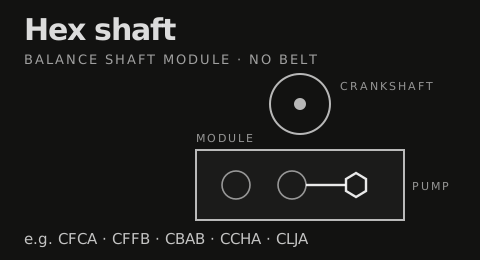
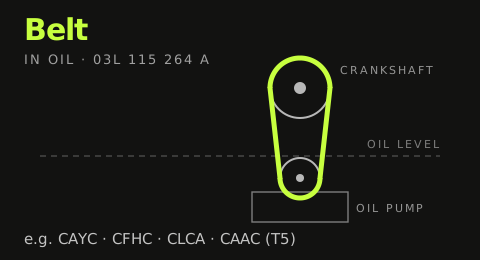
The shop checks which vehicles and engine codes fit, using your car: “Select vehicle” at the top, then choose the model or scan the registration document with your phone camera. If you only have the engine code, the shop lists them under “Engine code”. Not sure about your engine code? Write to us.
Check your vehicle in the shop2.0 TDI balance shaft module removal: what comes out and what drives the oil pump afterwards
The shorter path to the oil pump
From the factory, the oil pump sits at the end of a long drive chain: the crankshaft drives the module, inside it the first balance shaft drives the second via spur gears, and only the second turns the pump via the hex drive pin. Every link has play, and because the pump had to fit into the module, it is small (the whole chain in the wiki).
The conversion removes the module, the shafts, the drive pin and the original oil pump. The drive pin goes out together with the module — you no longer need it.
Replace the drive pin or remove the module: two options
2.0 TDI with balance shaft module (EA189 and unit injector)
Which parts fit your car? → Solution finder Only replace the drive pin → drive pin page Check kit fit in the shop
Text of the animation
- The long path: On the 2.0 TDI, the crankshaft drives the oil pump through the whole balance shaft module.
- Weak point: A small hex sits at the end. Once it rounds off: no oil pressure.
- Replace the drive pin: Defuses the acute risk with intact sockets (checkable only with the pan off). The path stays.
- Remove the module: Root-cause fix: module out, new pump chain-driven by the crankshaft.
- Two options: Which parts fit your car?
Whether the sockets (the hex seats) are intact enough for the drive pin only shows with the oil pan off; if in doubt, go straight for the conversion kit. Keyboard on the stage: space bar plays/pauses, ← → change the scene. Green = force, orange = oil or “comes out”, blue = MMHP drive pin and chain drive; the chain drive is only indicated. Schematic. Why the long path is the real problem is explained in the MMHP wiki. The two balance shafts sit side by side; the drawing shows them offset.
With the conversion kit (“Remove the module”): what comes out and what goes in.

- Balance shaft module with both shafts and spur gears
- Hex drive pin
- Original oil pump
- Module drive on the crankshaft (sprocket or spur gear, depending on version)
- MMHP high-performance oil pump, Stage 1 or 2
- new drive sprocket on the crankshaft
- chain with a purpose-designed tensioner and guide rail
- own pickup pipe and baffle plate
- together a conversion set of 20 parts
Why with a tensioner: every chain elongates while bedding in and slaps without a tensioner. That is why the chain in the conversion kit runs with a purpose-designed tensioner (why a chain drive without a tensioner is not an option).
And the vibration? Balance shafts smooth out the hum of a four-cylinder; the engine does not need them to function. After the conversion it runs a little rougher at low revs, especially at idle; most drivers get used to it quickly, those who want maximum refinement will notice (life without balance shafts, honestly calculated).
New module, reinforced drive pin or conversion kit: 2.0 TDI costs
Four routes compared
If the module has a problem or you want to prevent one, there are four routes. They differ in price, in the size of the job and above all in what stays in the engine afterwards. There are other partial fixes for the module as well; the wiki gives an overview (the market of half-solutions).
| Route | Parts | Labour | What remains |
|---|---|---|---|
| New or reconditioned module | Module from a parts dealer or reconditioner, price on quotation | Oil pan off, remove and refit the module; your workshop’s hourly rate | The same design: long drive chain, hex, small original oil pump. |
| Reinforced drive pin | €89.90 | Oil pan off, 1 to 2 hours | With intact sockets the drive lasts longer than the original; that only shows with the oil pan off. Module and small original oil pump keep working. To the drive pin |
| Conversion kit Stage 1 (+35 %) | from €299 Kit with MMHP oil pump, tools and eGuide | Oil pan and timing belt off, 2 to 4 hours | No module, no drive pin. Noticeably more flow rate; on some engines the reserve is not enough, though. The budget option. |
| Conversion kit Stage 2 (+116 %, recommended) | from €468 Kit with larger MMHP oil pump | as Stage 1 | No module, no drive pin, the larger reserve. Our recommendation; on the T5 with CFCA the only choice. |
Which route for whom? The reinforced drive pin is the choice when the sockets (the hex seats in balance shaft and oil pump) are still intact and the engine is young and healthy: it defuses the acute risk. However, the workshop can only see whether the sockets are intact with the oil pan off; if you want to open it only once and are unsure, go straight for the conversion. The conversion is also the choice when you want to be rid of the module for good, and all the more if the oil pan is open anyway (both routes in the wiki).
Prices from the shop, checked hourly; “from” = transverse engine. Transverse, longitudinal, T5 and Amarok/Crafter versions carry a small surcharge in the shop. Fitting times are averaged typical values; they depend on the vehicle’s design, the engine’s installation position and the mechanic’s skill.
Why we recommend Stage 2. Stage 1 delivers 35 percent more than the factory pump and is already a clear improvement. On some engines that reserve is not enough, though, and you cannot tell in advance which ones: nobody measures wear, production tolerances and oil condition before buying (you’re buying for an engine nobody fully knows). Stage 2 delivers 116 percent more and brings that reserve. Stage 1 is for those who deliberately want to save and accept the remaining risk.
VW T5 2.0 BiTDI (CFCA): here we supply Stage 2 only (why, in the wiki).
Why we count in percent of flow rate rather than in bar: oil pressure is not a fixed pump value, every engine is unique.
Conversion kit to remove the balance shaft module · Stage 2 from €468, Stage 1 from €299 · Kit with MMHP oil pump, tools and eGuide
To the conversion kit in the shop2.0 TDI conversion kit in practice: a workshop reports
What customers report
The conversion kit has been in service since 2015, in every installation position of this engine family. An example from a workshop:
“As an automotive repair shop specializing in engine and turbocharger repairs, we have been dealing for quite some time with low oil pressure on certain 2.0 TDI engines, especially at operating temperature and idle. Neither local workshops nor authorized service centers could solve it permanently. With the conversion, the oil pressure problem was completely resolved. We finally have a reliable solution to offer our customers.”
Before the conversion, the oil pressure warning kept coming on, and the gauge showed the reading on the left when warm at idle. After the conversion, the needle sits clearly higher.


What these photos show and what they don’t. The photos come from the customer’s workshop. We did not take the measurement, and engine speed, oil temperature and measuring point were not recorded. The gauge is accuracy class 1.6. For this class of instrument, manufacturers do not specify reliable accuracy below 1 bar, and the left photo sits right in that range. That is why we show the photos as an impression of the difference, not as a measured value. For the same reason we do not publish bar figures ourselves (oil pressure gauges · how we measure oil pressure).

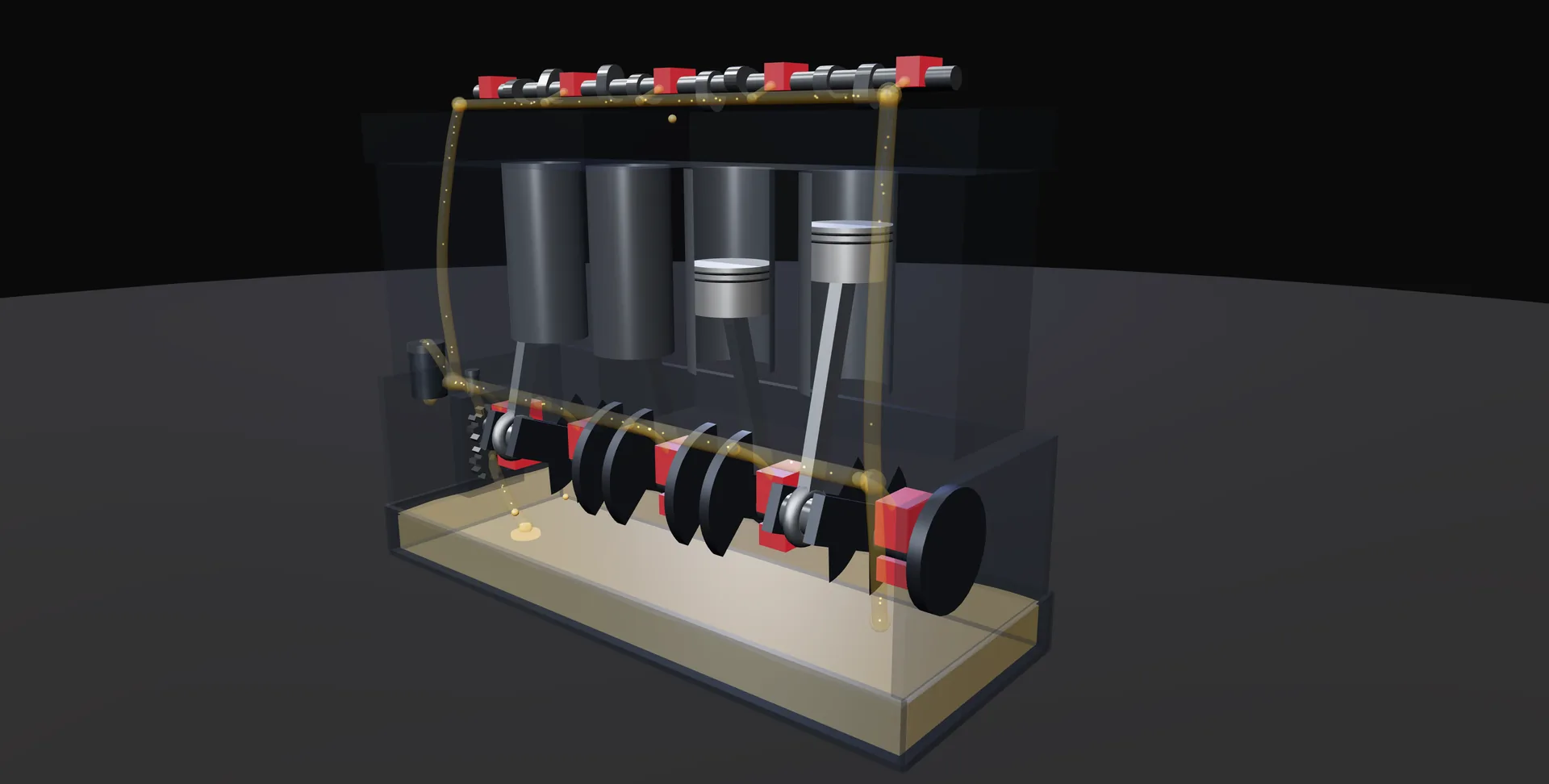
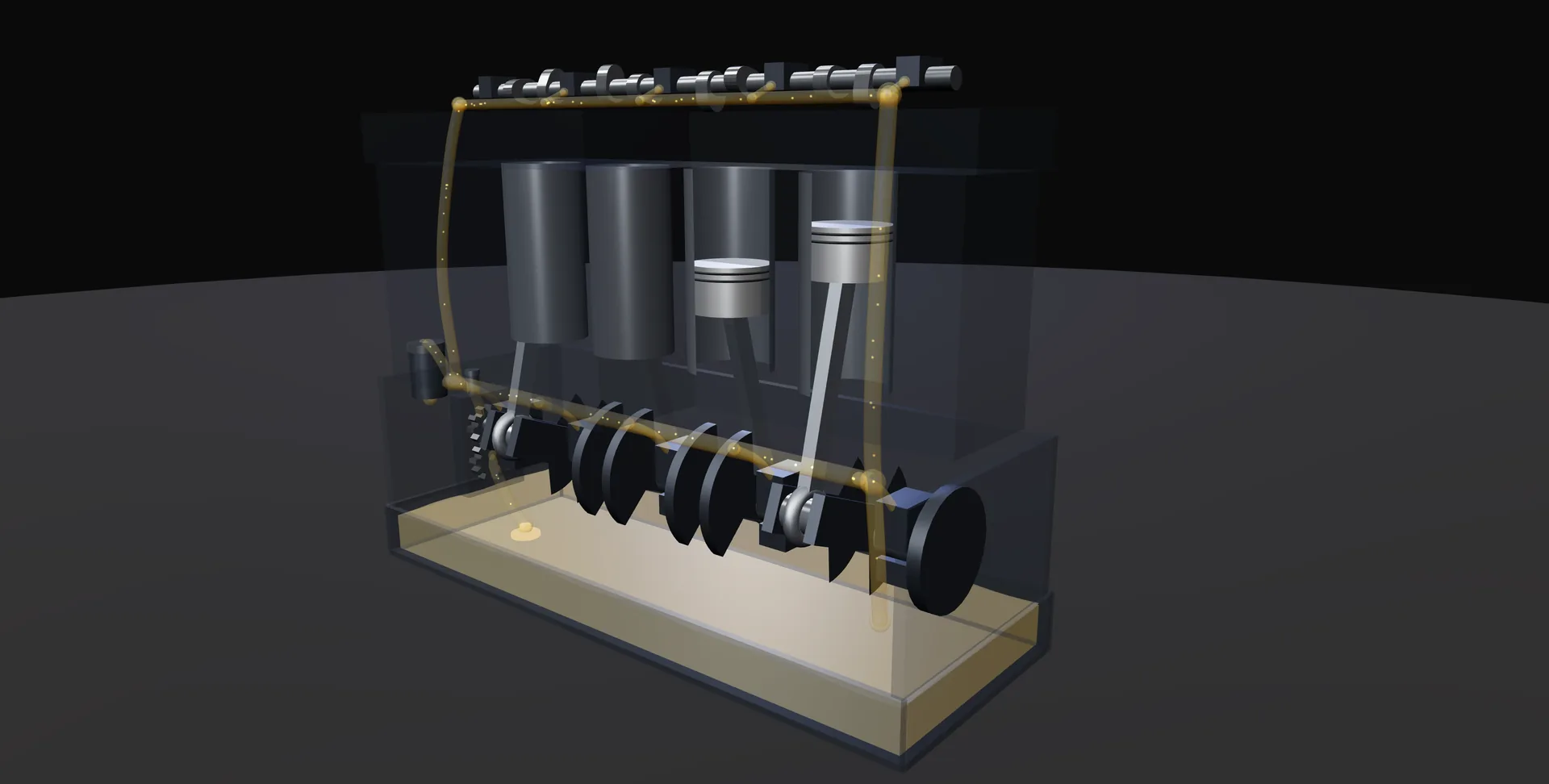
See when the oil pressure drops off
Rotate, adjust engine speed, compare stock against MMHP — in your browser, no sign-up.
Best experienced on a desktop or laptop — it runs on mobile, but space gets tight.
Fitting the 2.0 TDI balance shaft conversion kit: time, tools, workshop
The fitting
Time: 2 to 4 hours following the eGuide. That is an averaged typical value; it depends on the vehicle’s design, the engine’s installation position and the mechanic’s skill. The oil pan and the timing belt come off, because the new drive sprocket has to go onto the crankshaft.
Yourself or a workshop: both. You need the usual car-mechanic skills: timing belt, oil pan, shaft seals, oil pump, cutting threads. The eGuide takes you through the conversion step by step with pictures and is part of the package.
Choose the version: in the shop you select transverse engine, longitudinal engine, T5 or Amarok/Crafter, and the stage.
Scope of delivery:
- Online eGuide, German and English
- Conversion set of 20 parts with the chosen MMHP oil pump
- 6 fitting tools, positioning tools and a spur gear puller
Conversion kit with tools and eGuide · Stage 2 from €468, Stage 1 from €299 · choose the version in the shop
To the conversion kit in the shop
Balance shaft module removal on the 2.0 TDI: questions before you decide
Short answers, click a question
Does my 2.0 TDI have a balance shaft module?
The engine code decides (on German registration documents: field D.2), not the model or year. Whether the conversion kit fits your car is checked by the shop with your vehicle or a scan of the registration document (engine types in section 01).
Does the conversion kit fit pump-injector (PD) engines?
Yes, if the engine has a balance shaft module, for example BKP, BMP or BLB; for longitudinal engines (BRE, BRD) there is the longitudinal version. Pump-injector engines that have no balance shaft module from the factory (BKD, BMM, BMN, AZV) do not have this drive and do not need the conversion kit; it does not fit them either.
How urgent is the conversion?
There is no fixed interval. Wear on the hex gives hardly any warning, and the oil pressure light comes on late (the wear in the wiki). The conversion makes sense when the oil pan or the timing belt is due anyway. If the red oil light is already on: stop as soon as it is safe, switch the engine off and do not restart it until the cause is found; then have the oil pressure measured (reading the light correctly).
Buy a new balance shaft module or remove it?
A new or reconditioned module brings back the same design, with the hex and the small pump. The conversion kit removes both. The job is a little bigger, because the timing belt has to come off in addition to the oil pan (comparison of the routes).
What does the balance shaft module do, and does the engine need it?
It is there for refinement: the shafts smooth out the hum of the four-cylinder; the engine does not need them to function. Quite a few production engines of the same class come without them from the factory (why balance shafts exist).
Does a 2.0 TDI vibrate more without balance shafts?
A little, mostly at idle and at low revs. Most drivers get used to it quickly; those who bought the car for its smoothness will notice the difference (section 02).
Isn’t the reinforced drive pin enough?
The drive pin is the small hex part between module and oil pump. Our reinforced drive pin makes this drive more durable and defuses the acute risk while the sockets are intact; that only shows with the oil pan off. If you are not sure, go straight for the conversion: with worn sockets, the only other option is replacing the affected parts. The cause remains, though: the module and the small original oil pump keep working. If you want to relieve the engine for the long term, remove the module (to the drive pin).
Does removing the balance shafts harm the crankshaft?
No, and in everyday driving you will hardly notice it. Many customers notice no difference after the conversion. We have been selling the conversion for well over ten years without problems, including after several hundred thousand kilometres.
Does the balance shaft module have to be adjusted?
From the factory, yes: when it is fitted, the module is synchronised to the crankshaft with a setting tool. With the conversion kit this step disappears, because the module comes out completely.
Do I still need a drive pin after the conversion?
No. The drive pin goes out together with the module; the new pump runs without it.
Stage 1 or Stage 2 oil pump: which one do I need?
We recommend Stage 2 (+116 %). Stage 1 (+35 %) is a clear improvement, but on some engines its reserve is not enough, and you cannot tell in advance. It is the budget option for those who accept that remaining risk. On the T5 with CFCA there is only Stage 2.
Does the timing belt have to come off for the conversion?
Yes. The old sprocket or spur gear has to come off the crankshaft and the new drive sprocket goes on; for that the timing belt comes off. A new or still young timing belt usually does not need replacing; it can be refitted. Above a certain mileage it is worth changing it at the same time, because the belt is not expensive. Your workshop decides according to VW specifications.
Can I fit the conversion kit myself, and how long does it take?
Yes, with the usual skills of a car mechanic, the supplied tools and the eGuide, which takes you through the conversion step by step. You also need a torque wrench, the usual car tools and an oil pressure tester for the final check. Allow 2 to 4 hours; that is a typical value that depends on the vehicle, the installation position and your skill.
Does the engine block need drilling or thread cutting?
Depending on the block, a thread may have to be cut afterwards if a machining step was skipped when the block was made; you only see this after removal. Thread cutters and templates come with the kit, and the eGuide shows the step.
Do I need a different oil after the conversion?
No. The oil specification and change interval stay as the manufacturer specifies.
Does the chain in the conversion kit stretch?
Every chain elongates while bedding in. That is why it runs in the conversion kit with a purpose-designed tensioner that takes this up (chains elongate, all of them, always).
Does more flow rate harm the engine?
No. The pump’s pressure relief valve limits the pressure. The higher flow rate works where the factory pump delivers too little: at idle and at low engine speed.
What experience is there with the conversion kit?
The kit has been in service since 2015. A workshop in Bosnia and Herzegovina sent us its gauge photos from an Audi Q5 before and after the conversion (customer feedback in section 04).
Conversion set with MMHP oil pump, special tools and eGuide: recommended Stage 2 from €468, Stage 1 from €299. For 2.0 TDI with balance shaft module (common rail and pump-injector); not for engines that have no balance shaft module from the factory, and not for the EA288.
Conversion kit in the shop