MMHP Workshop Knowledge · VW / Audi / Seat / Skoda 2.0 TDI
VW 2.0 TDI Problems: Death by Oil Pressure Drive pin, balance shaft module, undersized oil pump: the weak points and their solutions, explained by the people who take these engines apart.
It almost always starts the same way. The oil pressure light flickers briefly, in a long bend or a few seconds after a cold start. Then it's quiet again. Many 2.0 TDI drivers know this moment, and most only find out afterward what it meant.
Search for 2.0 TDI problems and you'll find long lists: turbocharger, EGR valve, particulate filter, plus the emissions scandal that made the EA189 and EA288 engine families notorious. Most of that is real, annoying, and expensive. But there is one path that doesn't just cost money, it kills engines. That's the oil supply, or more precisely: an oil pump that ended up undersized for lack of space and, in stock form, is driven through a six-millimeter hexagonal drive pin (often called the oil pump hex shaft).
This article has been one of the most-read pages on mm-hp.de since 2024. For this edition, we rebuilt it from the ground up and added everything we've learned since in our research and teardown work. It walks through the whole chain: what problem areas this engine has, why the oil pump of all things became the weak point, how to spot the wear early, and which fixes actually hold up. Two real cases from our customer base are included.
Contents: 01 The problem map and engine codes · 02 Design · 03 The drive pin · 04 Two drives · 05 The Hayri case · 06 Misdiagnosis · 07 Warning signs · 08 Oil consumption · 09 Solutions compared
The 2.0 TDI problem map: plenty of trouble, one killer
Built by the millions, in the Passat, Golf, Tiguan, A4, A6, Superb, Octavia, and many more. An engine built in these numbers inevitably collects well-known weaknesses. The table sorts them honestly, then we zoom in on the one that carries this article.
| Problem area | Typical picture | Assessment |
|---|---|---|
| Turbocharger | Power loss, whistling, oil consumption through the shaft | Expensive, but usually gives warning. Often a consequence of poor lubrication, not its cause. |
| EGR valve | Jerking, limp mode, warning light | Common and annoying, but easy to diagnose and not fatal for the engine. |
| Particulate filter / temperature | Frequent regenerations, rising consumption | Often a secondary damage. Why oil consumption fills the filter is covered in section 08. |
| Oil pump belt (a wet belt running in engine oil) | Belt degradation, particles in the oil strainer (later EA189 variants, EA288) | Its own damage pattern with its own solution, mentioned here only for context. |
| Oil supply: module, drive pin, pump | Flickering oil pressure light, sudden loss of pressure | The path that kills engines. Self-accelerating wear, abrupt end. The rest of this article. |
Two rows in this table deserve a second look. The turbocharger is often cast as the culprit, when in many cases it's actually the first victim: a turbo starved of oil dies before the engine does, without revealing what set the dying in motion. And the last row carries the green dot because it differs from all the others in one respect. EGR and filter issues announce themselves over weeks. The oil pump drive works unnoticed for years, then fails within a short span of time.
Which 2.0 TDI do you have? Matching engine codes (CAHA, CFHC, DFGA …)
Before we go deeper, a sorting question we run into in support every day. Whether your engine can even have the problem described here depends solely on the engine code letters. They're printed in field D.2 of the German registration document (elsewhere: the engine code sticker or service booklet), not the model, not the year, not the horsepower figure. Whether 140, 150, 170 or 190 hp: the power output doesn't tell you which oil pump design is fitted, only the engine code does.
| Variant | Example engine codes | Oil pump drive | Covered by this article? |
|---|---|---|---|
| EA189 (common rail) with balance shaft module | CBAB, CBBB, CFFB, CFGB, CFGC, CAGA, CAHA, CAHB, CJCA, CGLC, CLJA, CCHA (T5), CFCA (T5 BiTDI) and others | Chain or spur gears, then module, then hexagonal drive pin | Yes, core topic. Drive pin or conversion |
| Pump-nozzle (EA188) with balance shaft module | BKP, BLB, BMP, BMR, BNA, BRE, BRF, BRT, BUZ and others | As above: module and hexagonal drive pin | Yes, same damage pattern. |
| EA189 without module | CFHC, CFHF, CLCA, CBDC, CFJA, CAYB, CAYC (1.6), CAAC (T5), CKTC (Crafter) and others | Its own oil pump belt in the oil | Its own problem, its own solution: EA189 chain conversion |
| EA288 (1.6 and 2.0 TDI) | CRLB, CRBC, DFGA, DFEA, CUNA, CUPA, CNHA, DCYA, CLHA (1.6), CXXB (1.6) and many others | Oil pump belt runs in oil | Its own problem, its own solution: EA288 chain conversion |
| EA288 evo (05L oil pump on the upper oil pan) | DTRA, DTSA, DTSB, DTUA, DFBA and others | Different design | The chain conversion does not fit here. Ask us before purchasing. |
The table lists the most common engine codes (as of September 2026, from our fitment database). We deliberately maintain complete engine and vehicle lists in only one place: the fitment lists in our shop and in the solution finder. A list in an article goes stale quietly, and on this question, quiet staleness is dangerous. If you're unsure: note your engine code letters and click through the solution finder, it takes less than two minutes.
An oil pump at the end of a long chain
To understand why this engine has an oil problem, you need to follow a design decision that looked elegant on paper.
An inline four-cylinder hums by design. Its pistons move in pairs, opposed to each other, which cancels out the coarse inertial forces, but a finer vibration at twice crankshaft frequency remains. For a Passat or A6, VW didn't want to accept that hum. The solution is over 120 years old and comes from the British engineer Frederick Lanchester: two counter-rotating balance shafts that, spinning at twice crankshaft speed, generate exactly the opposing forces needed. A proven principle, nothing wrong with that.
The story of this engine isn't really about THAT balance shafts were fitted, but HOW. The designers packed both shafts into a shared housing in the oil pan, the balance shaft module. And since work was being done down there anyway, the oil pump moved in as well. From a manufacturing standpoint that was elegant: one assembly, one operation. From an oil supply standpoint, it started a chain of dependencies you find in hardly any other engine.
Let's trace the power path. The crankshaft drives the module. Inside the module, the first balance shaft drives the second via spur gears. And the second shaft, through a small hexagonal pin, finally drives the oil pump. The engine's most important ancillary component, the sole source of its oil pressure, hangs at the end of a chain made up of several gear meshes, two shafts, and a pin. Every link has play, every link wears.
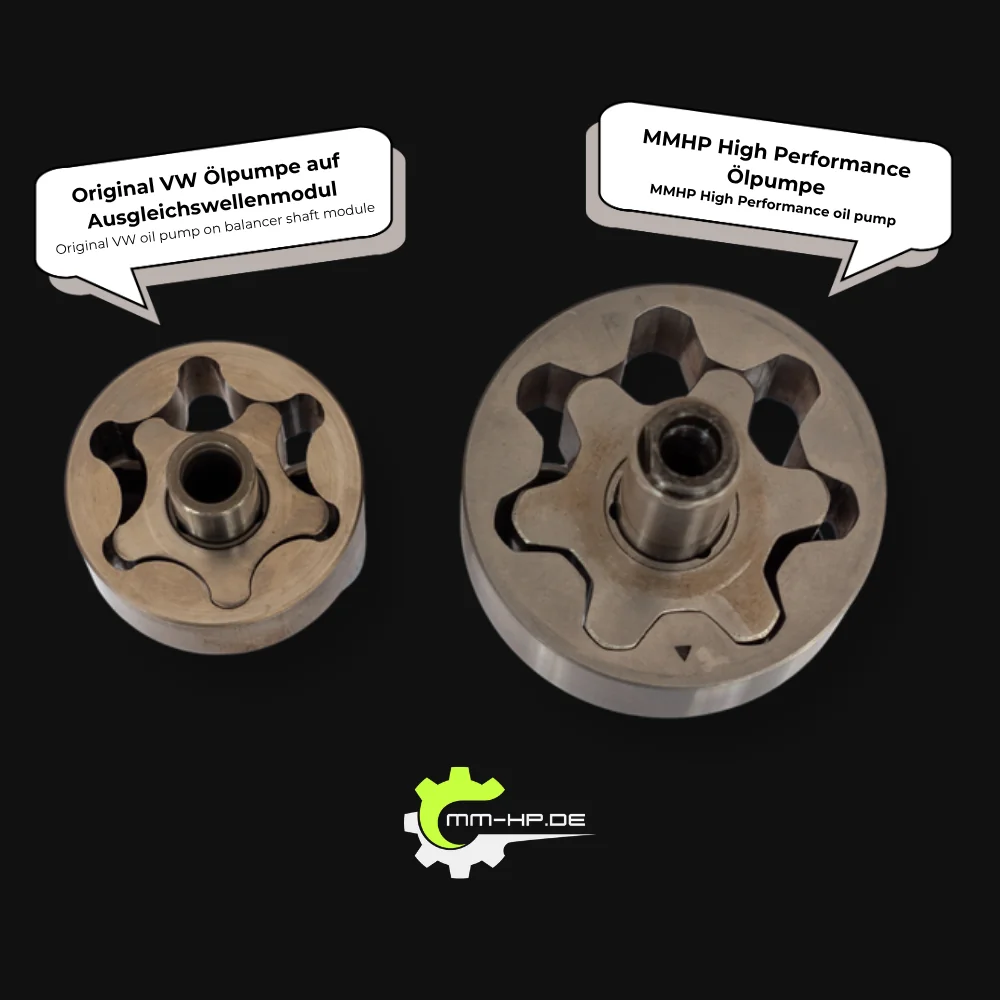
On top of that comes a space problem with consequences. Because the pump had to fit inside the crowded module, it ended up small. A small pump can only make up for its delivery volume through speed, so it was geared up and spins fast. High speed means high load exactly at the component that transmits the force. And it also means: little reserve. According to our measurements, this system runs in stock form with essentially no buffer to spare.
So this design doesn't have one weak point, it has two that hide each other. The loud one is the drive pin. The quiet one is the pump itself.
The 6-millimeter pin the original system hangs on
The hexagonal drive pin is the most unassuming part in this chain. And its most notorious.
The drive pin is a hexagonal pin about six millimeters across the flats. It sits in bushings on the second balance shaft and on the oil pump and transmits the pump's entire drive torque, at twice crankshaft speed. On the motorway that's five to six thousand revolutions per minute, hour after hour.
That could hold up for a long time if the form fit were perfect. It isn't. Industry discussion documents bushing eccentricities of up to 0.1 millimeters, on top of the manufacturing play between the hexagon and the bushing. Instead of bearing across its full face, the pin runs on its edges and hammers against the bushing walls with every load change. Millions of times.
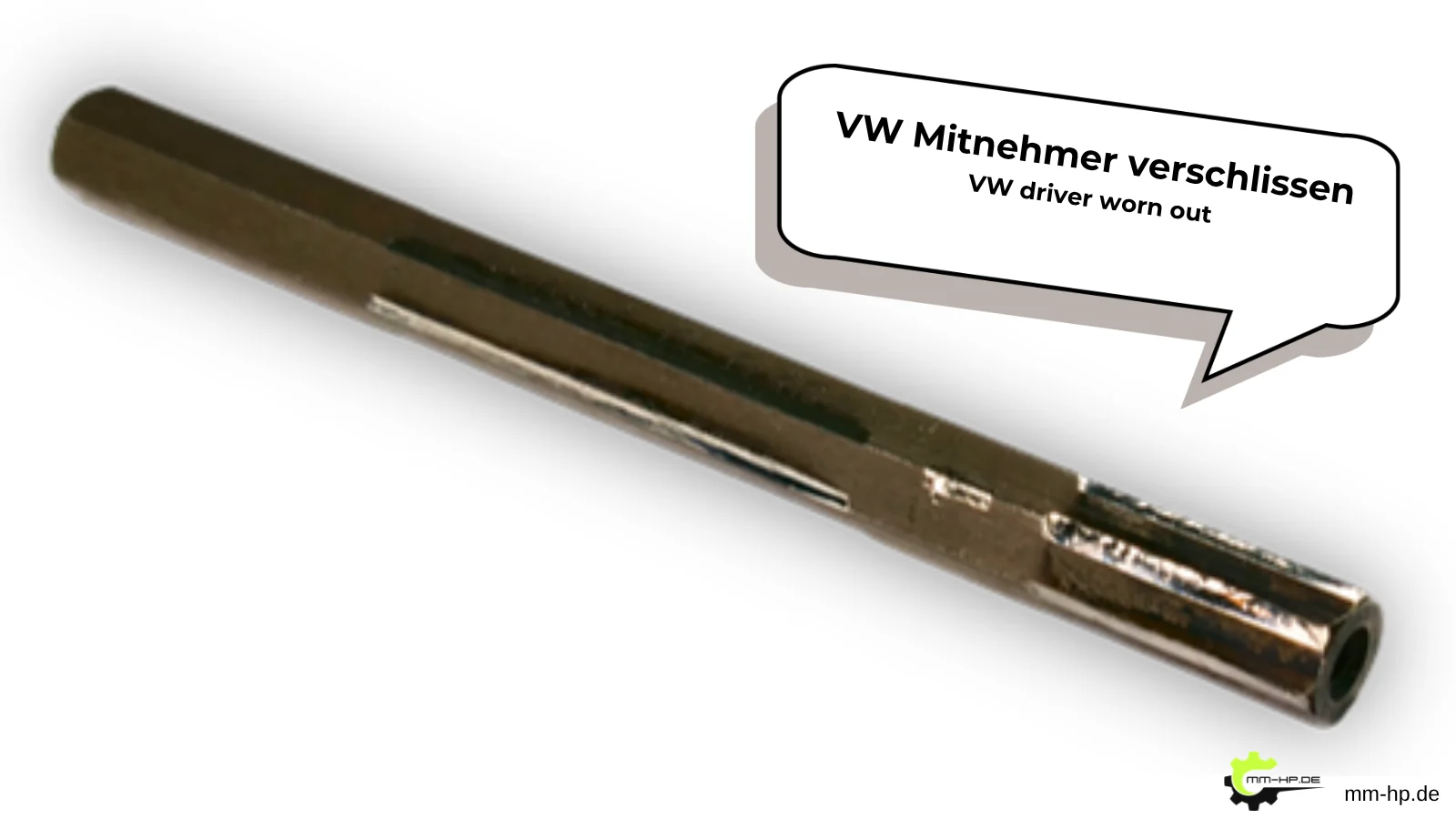
This is where the mechanism that makes this failure so treacherous kicks in: it accelerates itself. Every impact abrades material, and the play grows. More play means more run-up before each impact, so harder impacts, so faster material loss. An exponential process, unremarkable for years, then dramatic within a short time. Eventually the six edges are rounded off so far that the pin spins freely in the bushing like a stripped screw under a worn-out bit. The oil pump stops. Oil pressure collapses. From that point, it's a matter of seconds.
The photo on the right shows what that looks like. The edges of the removed original part are visibly rounded off, the hexagon has become almost a circle. The technical drawing below shows what's at stake: a hexagon with width across flats SW, length L, and a fit that decides whether the engine lives or dies.
What the manufacturer knew, and what became public in 2013
This isn't a workshop myth. In May 2013, German motoring magazine AUTO BILD made the 2.0 TDI's oil pump drive the subject of a report. VW told the editors the cause was "tolerance deviations" in the oil pump drive, a remarkably candid description of exactly the mechanism you just read about. The hexagonal shaft, they said, could "round itself out" and fail abruptly, with consequences ranging from turbocharger damage to total engine failure. The report named the Passat and Sharan, Audi A4 and A6, Skoda Superb, and Seat Alhambra from model years 2005 to 2009, with confirmed case numbers in the hundreds. A blanket recall never happened.
The manufacturer did respond, just quietly: from around 2010, the drive pin was lengthened from 77 to 100 millimeters to reduce the contact pressure in the bushings. A genuine improvement. But not a fix for the underlying problem, because eccentricity, play, and the small, fast-spinning pump all remained. Field reports show failures clustering between roughly 100,000 and 160,000 kilometers. That's not an old-car problem, that's the middle of a car's life, often shortly after a used purchase.
One thought belongs here already, before we get to the solutions: the drive pin isn't an unavoidable component. It only exists because the stock pump sits on the balance shaft module and needs to be driven somehow. Our reinforced drive pin makes this component more durable, as long as the bushings are intact (which only shows with the oil pan off). The conversion in section 09 takes the other route and eliminates it entirely, bushing and all, so there's nothing left to round itself out.
Key takeaway: drive pin wear is exponential. An engine that runs unremarkably today can be at the end of that curve within a few thousand kilometers. Prevention here isn't excessive caution, it's arithmetic.
First chain, then spur gears: two drives, one outcome
The drive from the crankshaft to the module exists in two production versions. Their history is a lesson in why swapping parts doesn't fix a design problem. We know both from our own teardown work.
The early modules were chain-driven, and this variant developed a particularly vicious mechanism. The chain and its sprockets often wore quickly, up to and including chain breakage. But the truly treacherous part was its coupling to the drive pin: the module chain was tensioned by a hydraulic tensioner, itself a component that depends on oil pressure. If drive pin play grew and the pump was no longer driven cleanly, oil pressure dropped, and with it the tensioner's clamping force. The slackening chain began to slap and gradually tore apart the whole drive unit. A perfect vicious circle: the wear on one component removed the operating basis of the other's protection system. The diagram on the right shows this spiral.
Because that couldn't be controlled, VW switched to spur gears. One gear on the crankshaft, an idler gear, a gear on the module shaft. More robust on paper, tricky in practice: the gears require precisely set backlash, the module has to be synchronized to the engine with special tooling during assembly, and in operation the clearance didn't stay where it belonged. Heat and lubrication changed the gear backlash, and the never-quite-smooth running of a combustion engine subjected the tooth contact to constant impacts. The spur gears also failed frequently, and this problem still hasn't been fundamentally solved to this day.
The punch line of this double story: the drive pin and the undersized pump sit in both variants. The manufacturer changed the drive TO the module twice and left the problem INSIDE the module untouched. So anyone facing a repair decision today shouldn't ask which drive variant they have. They should ask whether they want to renew, for a third time, a design that has already worn out both variants.
The Hayri case: 50,000 kilometers with the reinforced drive pin
Theory is one thing. Here's a documented case from our customer base, with video of the removal.
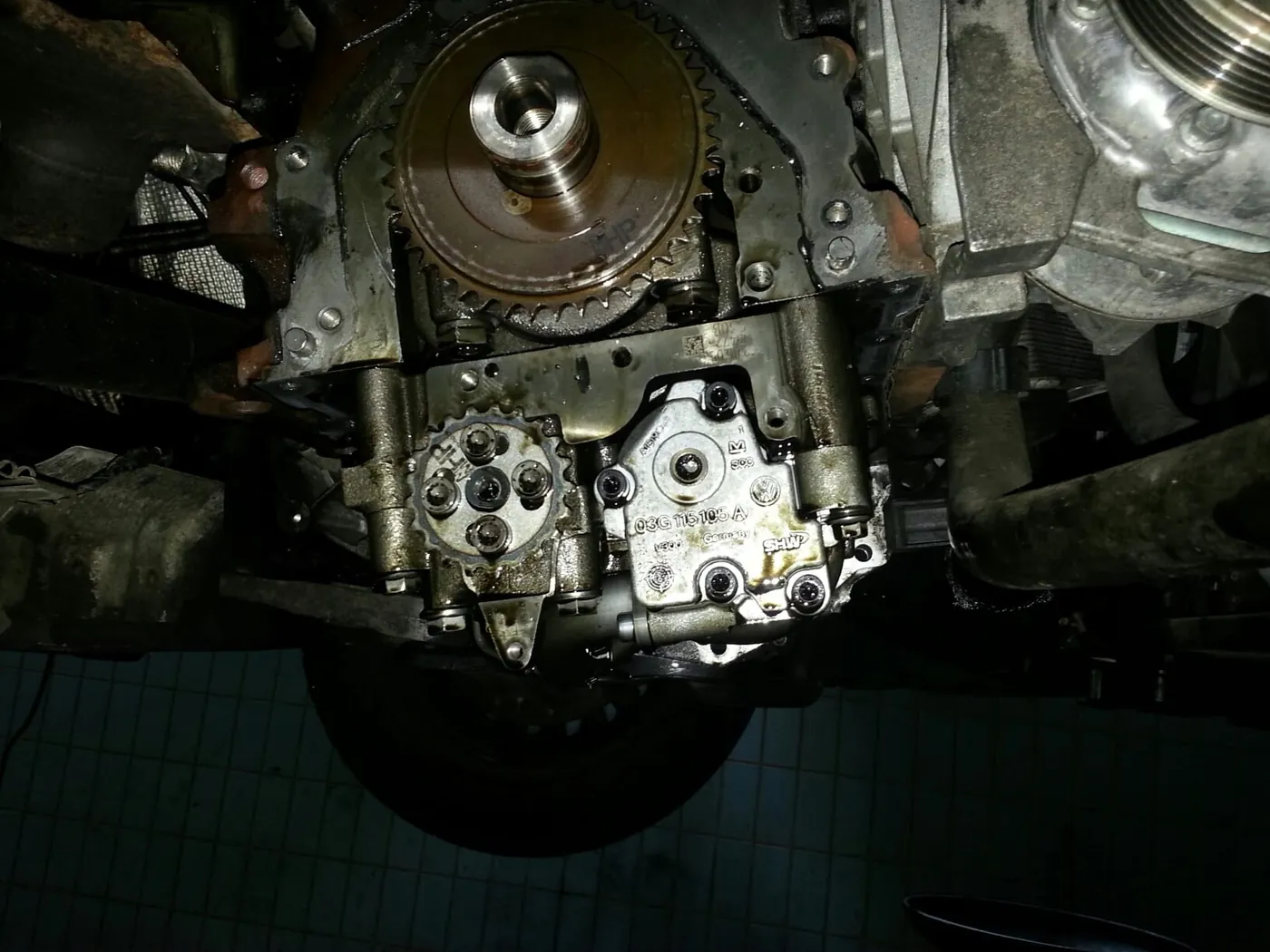
Hayri drives a VW Passat and, after doing his own research, chose our enlarged and reinforced drive pin in 2019. Like many owners, he knew the stories about the original pin spinning freely and didn't want to wait out the risk. The MMHP drive pin is hardened, specially coated, and deliberately machined to a tight fit against real-world bushing tolerances, so the play that wear draws its energy from grows more slowly, as long as the bushings are intact.
In 2024, Hayri checked the part after around 50,000 kilometers: he dropped the oil pan, removed the drive pin, and documented its condition. That inspection is exactly what the video shows. Two things about it are instructive. First, the condition of the part after 50,000 kilometers, which you can compare against the hammered-round original parts from section 03. Second, Hayri's decision to renew both the drive pin and the oil pump as a precaution while he was in there. You could call that overcautious. Anyone who has understood the exponential curve from section 03 calls it consistent.
This case deserves some context, and we repeat it deliberately at every opportunity: even the best drive pin only slows the wear process, it doesn't eliminate it. The small pump, along with its long drive chain, stays in the engine. What that means for choosing between the solutions is sorted out in section 09.
Two oil changes in two months: anatomy of a misdiagnosis
The second case shows the other side of the problem: what happens when the symptom gets repaired instead of the cause.
A customer was driving his 2.0-liter TDI Passat to work when the oil pressure warning light flickered on and off again. The first workshop replaced the oil pressure switch and did an oil change. A few weeks later, the light was back. So: a second oil change, symptom treatment again. Two oil changes in two months, and the problem still came back.
The turning point came from a second workshop that took the time to actually measure oil pressure. The result: the pump no longer built up reliable pressure, and the pressure fluctuated dangerously. The cause sat exactly where sections 02 through 04 would have you suspect, in the balance shaft module and its drive pin. Facing a four-figure bill to have the module rebuilt, the customer looked for alternatives and found our conversion method, which removes the module entirely. That decision saved his engine before the bearings ran dry.
This case represents a pattern we see constantly in support. A flickering oil pressure light gets answered with fresh oil or a new switch, because both are quick and cheap. But this engine's oil pressure switch doesn't measure a trend, it's a simple switch with a low threshold. By the time it trips, pressure is already in the basement. Changing the oil at that point buys a few quiet weeks and burns exactly the time in which the engine could still have been saved. Incidentally, fault code P047F00 often shows up in the memory in this context. If you've read that code, keep reading here.
Key takeaway: an oil pressure warning calls for an oil pressure measurement, not an oil change. Measure first, then decide.
How to spot it early
The wear announces itself more quietly than the warning light would have you believe. These signs are worth taking seriously.
| Observation | What could be behind it | What makes sense now |
|---|---|---|
| Oil pressure light flickers briefly | Pressure dips under load or in bends, the pump is no longer being driven cleanly | Don't dismiss it. Have oil pressure measured, read the fault memory (P047F00). |
| Rattling or metallic clicking from the oil pan | Play in the module drive, a slapping chain or gear teeth | Get it diagnosed by a specialist, don't just keep "monitoring" it. |
| Rising oil consumption | The start of the blow-by chain, see section 08 | Document consumption in writing, look for the cause instead of just topping up. |
| Frequent particulate filter regenerations | Burnt oil fills the filter with ash | Combined with oil consumption, a clear signal, read section 08. |
| Red oil pressure light stays on | Pressure is gone, the pump may have stopped entirely | Stop immediately. See box. |
⚠ Warning, red oil pressure light
If the red oil pressure light stays on, stop and shut off the engine immediately. Without oil pressure, the bearings run dry within seconds, and every additional kilometer can turn a repair into a total loss. Don't drive on to the next stop, don't "just quickly get home".
Notable about this list: the early signs are all quiet. It's precisely in this phase that people most often just top up the oil, tune it out, and keep driving, and that's exactly when intervening would be cheapest. The warning light itself is a poor early-warning system, as the previous sections have shown. Anyone who wants an honest answer from their engine can't get around an oil pressure measurement.
The oil pump drive in the 2.0 TDI is under-engineered from the factory.
That is our claim, on our own site. It does not stand alone.

By the time the red light comes on, the damage has
already been done.
VW and Skoda confirmed case numbers
in the three-digit range
to the editorial team, and Audi ran
service campaign 13D7 in response.
- Report
- “VW-Konzern-Motor 2.0 TDI: Ärger mit der Ölpumpe”, 7 May 2013
- Covers
- Pump-injector engines, built 2005 to 2009
- Quotation
- Excerpt, published in German, translated by us
The quiet second failure: oil consumption and the blow-by chain
Oil pressure is the acute danger. Oil consumption is the slow-creeping one, and people have been telling the wrong story about it for years.
"The rings are shot, the engine is pumping the oil through." That's the line in a thousand forum posts. The effect is real, but our measurement series on purchased and disassembled engines show it isn't the main pathway. Most of the oil takes a different route. Coked, sticking piston rings no longer seal the cylinders cleanly, so on every stroke, significantly more hot combustion gas shoots past the rings down into the crankcase, roughly double the normal value on worn engines. On the way through the hair-thin ring gaps, these gas flows tear along the oil film and atomize it into an extremely fine mist, with droplets in some cases under a micrometer.
The stock crankcase ventilation isn't built for this fine mist. Its separators work by inertial separation, and that's exactly what's missing from droplets this small. So the mist travels through the ventilation into the intake tract, and the engine sucks in its own oil charge and burns it. In pronounced cases you can even hear it: the engine starts to knock because the ingested oil-air mixture ignites uncontrollably.
From there, the consequences cascade. Burnt oil leaves unremovable ash in the particulate filter. Our rule of thumb from many accompanied cases: after roughly 50 liters of burnt oil, the filter is saturated. Regenerations become more frequent, they carry diesel into the oil, the diluted oil lubricates worse, wear increases, and even more mist is generated. A spiral that explains why, past a tipping point, such engines don't gradually get worse, they crash.
Universal aftermarket oil catch tanks don't solve this according to our tests, they fail on the same ultra-fine mist as the stock separators, and an overfilled tank becomes a real hazard to the engine. That's why we're developing our own separator solution, and in extreme testing we reduced the oil consumption of a severely damaged test engine from 6.7 to 0.8 liters per 1,000 kilometers. How it works in detail, we're keeping to ourselves until it's market-ready. We're gathering more depth on this whole topic in our knowledge base, for example in the article Blow-by and oil mist.
What actually helps: the routes compared honestly
Once you've identified your module problem, you'll find a well-stocked market. The routes on offer sound similar and differ fundamentally.
Route one is a new original module, documented in the range of 1,300 to 1,700 euros plus installation. What you get is exactly the same design all over again, drive pin principle and small pump included. The clock gets turned back, not stopped. Route two is a rebuild: specialists renew the worn bushing and fit the long 100-millimeter hexagon. Often solid workmanship, but conceptually the same applies, the weak point gets renewed, not removed.
What stands out when you survey this market: nobody publicly asks whether the pump in this design is even sized correctly in the first place. Yet according to everything our measurement series show, that's the second half of the problem, one that remains even if the drive holds up. That's why we offer two solutions and say openly what each one can and can't do. The diagram shows schematically what the pump question is about: delivery reserve across the entire rev range.
| Reinforced drive pin (V3.1) | "Without balance shaft module" conversion | |
|---|---|---|
| Character | The honest symptom fix | The root-cause fix |
| What happens | A hardened, coated hexagon with a tight fit replaces the original part | The entire module is removed, a directly driven, larger high-performance pump takes over |
| What stays | The module, the long drive chain, and the small pump stay in the engine | No more drive pin, no more gear-mesh chain, for the first time a pump with reserves |
| Track record | Four development stages, years in the field, see the Hayri case | In the field since 2015, fitted tens of thousands of times, with an eGuide for installation |
| Fits when | Bushings still intact (only visible with the oil pan off), engine is young and healthy, want to quickly defuse the single biggest risk | You want peace of mind, the oil pan is already open anyway, or you are unsure about the bushings |
| Drive pin in detail | Conversion in detail |
Two honest caveats belong here. The drive pin's tight fit requires intact bushings, if the bore is already worn oval, there's no way around replacing the affected parts, or going straight to the conversion. And the conversion reliably raises the question of vibrations. The balance shafts provide comfort, not a function the engine would be damaged without. Quite a few production engines in the same class run without them from the factory, including from the same group. Afterward, the engine idles a bit rougher, a four-cylinder being a four-cylinder, but mechanically it's rid of an entire failure cascade. Everyone should know that beforehand, not after.
For the variants with an oil pump belt running in oil there's a separate route, the chain conversion: for the EA189 without balance shaft module and for the EA288. The T5 and Amarok BiTDI (CFCA) is a special case: for this engine we supply only stage 2 of the conversion kit, our wiki explains why. Which case is yours is sorted out by the solution finder, and if in doubt, our support team: give us your engine code letters and some background, and you'll get the technically appropriate recommendation. Even if it turns out to be "just the drive pin for now." Answers to the most common installation and ordering questions are collected on our FAQ page. Background in the MMHP wiki: Timing belt in oil: affected engines, symptoms, interval.
Next step
Which solution fits your engine?
Grab your vehicle registration document, read off the engine code, and answer three questions. The solution finder places your engine and shows the right route, from the drive pin through the conversion to the chain conversion.
Transparency note: MMHP develops and sells the reinforced drive pin as well as the "without balance shaft module" conversion system. The technical descriptions are based on publicly documented sources and our own teardown and measurement work. Market and cost figures are marked as reported and may change. Diagrams and technical drawings on this page are schematic illustrations, not dimensional drawings or measured data.
First published on May 29, 2024. Thoroughly revised in July 2026 and expanded with the chapters on the problem map, drive variants, misdiagnosis, warning signs, and oil consumption.